


What’s the weather like in San Francisco right now? Getting an answer is easy, fast, and accurate. What about 5 miles offshore, at a depth of 12 meters? That’s harder to answer. We make it easier with a Smart Mooring system that can be added to the Spotter buoy.
Smart Mooring brings modularity to subsurface sensing through a single universal interface. The Spotter buoy provides power and connectivity for seamless real-time access to data. The Spotter + Smart Mooring system gives researchers, coastal engineers, and anybody who’s wanted to know what’s going on down there hyper-localized or regional awareness of parameters traditionally captured by set-and-forget loggers. In practice, that means data loggers can be converted to real-time.
Sofar Ocean has built and deployed thousands of Spotter buoys, creating the largest privately-owned marine weather sensor network in the world. This network fills in the gaps in real-time ocean and weather data. With Smart Mooring, we bring that same level of insight underwater.
There’s a critical missing layer of ocean data: real-time information from below the surface. Satellite data has produced large amounts of sea-surface data in real-time, but it lacks depth. New and ever-cheaper data loggers give us insight into subsurface environments, but it’s months or sometimes years before their retrieval. Smart Mooring provides the best of both worlds.
One advantage of real-time monitoring over traditional data logging is that there is no missing data due to failure or loss of the device. A common complaint with loggers is that there’s no way to tell after installation whether the logger is still collecting data, has lost its calibration, or is functioning correctly. With a Smart Mooring system, data quality and assurance is immediate and constant.
Another advantage of real-time monitoring is that there are no limitations on deployment time due to power or data storage. While many modern loggers have large battery and storage capacity, some situations require sensors with higher power needs that can’t be met by battery power alone.
Lastly, real-time monitoring provides peace of mind. Since each system is equipped with GPS on a surface buoy, it’s far easier to locate or recover if lost or misplaced.
The Smart Mooring system handles power, data, and mechanical fastening through a single simplified cable.
Combining power and data on a single, thin cable overcomes several challenges with moored systems. There is less weight and less mass for deployment. Less drag means less weight and flotation are needed to secure the mooring in place. The system is small and lightweight enough to be deployed from a small boat. Less weight and size also mean it can be shipped economically by air or standard ground transportation, and it’s easy to hand-carry and load onto commercial or freight (UPS, FedEx, DHL) flights.
The cable is Kevlar-reinforced and rated for a maximum working load of 1,780 N (~400 lbf), and it has been tested for 200+ continuous cycles over a 4.25” sheave with a 3” capstan. In addition to being functional, it’s strong and abrasion-resistant for tough maritime applications.
The core idea behind Smart Mooring is that every part of the system is configurable and customizable. Cable comes in lengths of 5m, 10m, 20m, 25m, 35m, and 50m, and each length can be connected to a sensor node, a mooring termination, or another length of cable using simple hand tools in the field. You can add up to three subsurface sensor nodes throughout the water column, and each node is itself swappable—allowing a different sensor at each position.
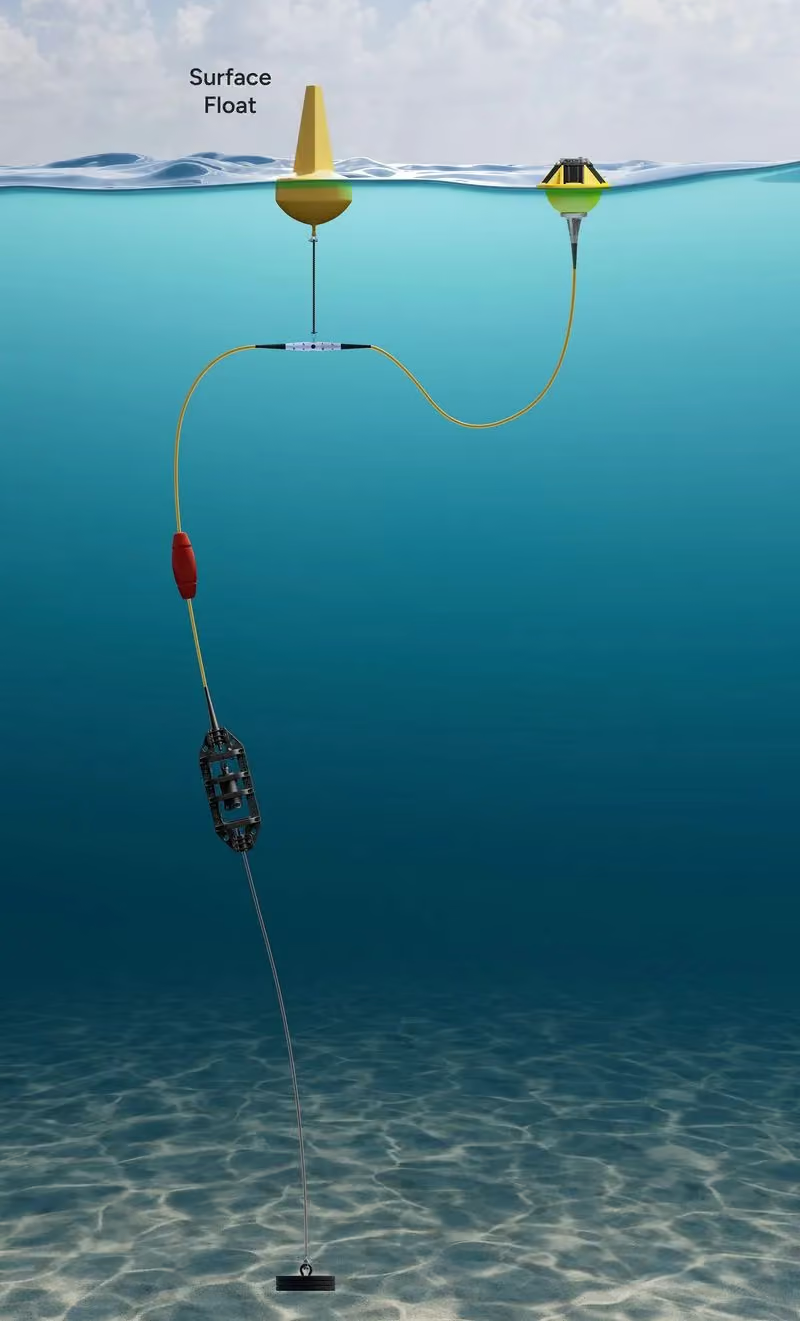
The entire Smart Mooring system was designed with OEMs and integrators in mind—both for new devices and sensors and for integrating existing hardware. Data flows to and from these devices via the API and is supported with developer tools and examples.
Nodes are universal and extremely durable. Add up to three subsurface sensors throughout the water column, then colocate and combine that subsurface data with Spotter’s surface measurements to maximize understanding of the operating environment. Available nodes include:
*Maximum working load and winch/capstan use guidelines are calculated and tested using new cables. Repeated use and various mooring configurations and environmental considerations may alter these guidelines.
It’s not enough to have a specialized piece of equipment. Coastal and ocean challenges require a systematic approach. As Sofar CEO Tim Janssen has put it:
“One of the biggest barriers to ocean sensing and monitoring is the lack of a universal connector and communication protocol. We’re out to change that. Smart Mooring is built on top of an open standard—we want you to be able to use any sensor you want, and place it where you want. The variation is limitless. All connectors are identical, and everything is interchangeable. We like the ease and flexibility of USB, so we set out to build it for ocean sensing. Plug it in and the data shows up on your dashboard and API. It’s that simple.”
That open standard is Bristlemouth—the connectivity backbone that makes adding and swapping sensors as straightforward as plugging in a USB device. Bristlemouth-enabled nodes let you easily add custom or off-the-shelf sensors as your needs evolve.
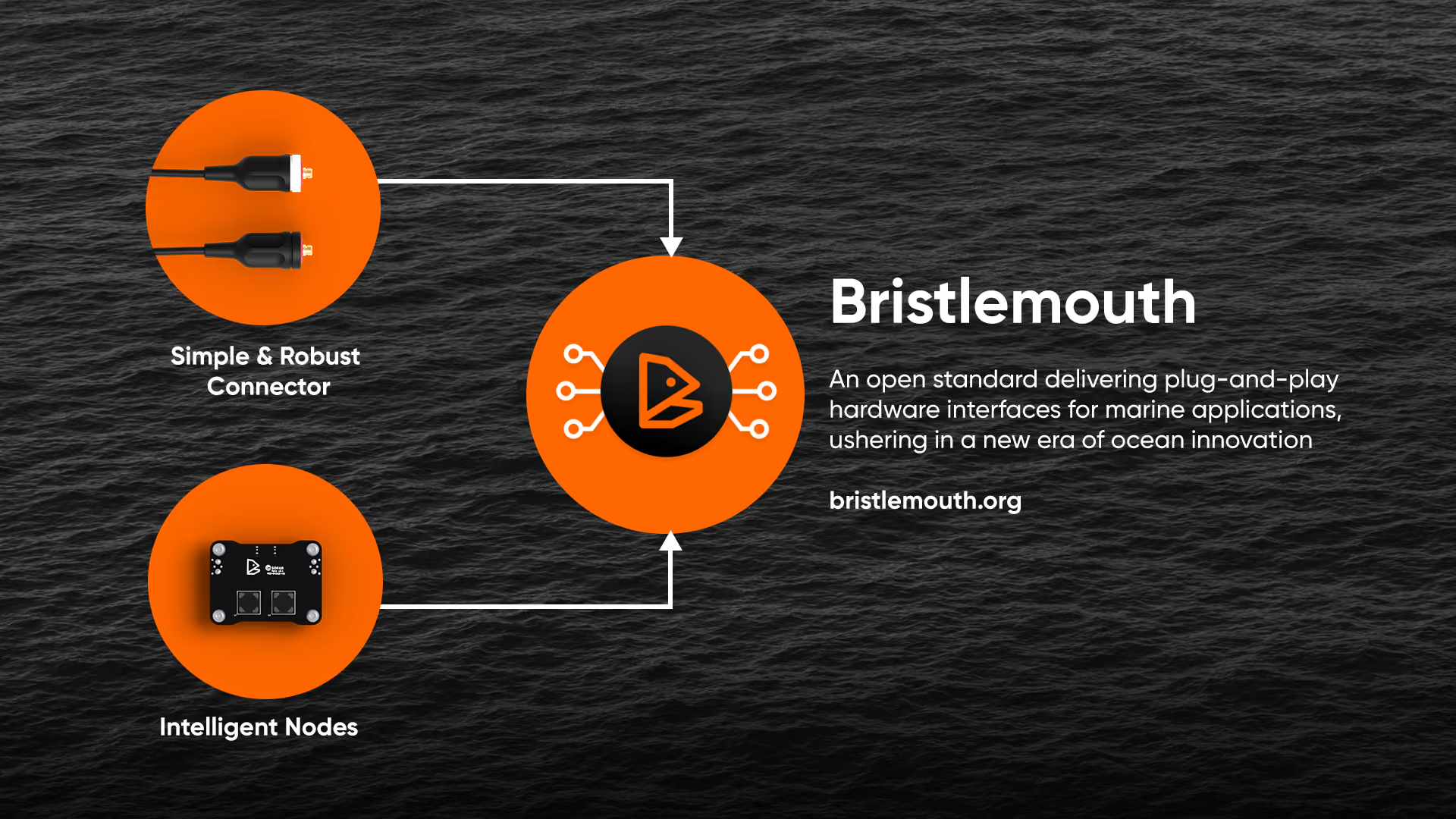
Smart Mooring is a platform our partners can build on for industry-specific applications. Explore the available configurations, or reach out to sales to customize your own.
