In “The 5-10% Illusion,” a new report from maritime technology research firm Thetius, a shipping stakeholder offers a sobering assessment of the savings claims made by voyage optimization providers:
"I hear 5-10% fuel savings so often that I no longer believe any of them."
We agree. Year after year, we have watched our industry promise more savings with less proof, and have fielded increasingly pointed questions from customers and prospects about the differences between our gains methodology and that of our peers. All parties want clarity — operators to separate truth from marketing, and worthy suppliers to separate themselves from the pack.
As a team of ocean scientists and maritime experts, we think the right response to this muddled savings picture is methodological transparency. In this blog, we’ll explain our rigorous, science and data-driven approach to calculating gains, detail how it differs from other methodologies, and share fleetwide results from our global customer base that demonstrate our impact.

Every voyage optimization provider makes assumptions when they report savings. Once you intervene in a voyage — adjusting speed, changing the route — you can no longer deterministically say what the results of not intervening would have been. You can model it, but you can't observe it.
Without a perfect counterfactual, voyage optimization providers must choose a benchmark for performance and compare it to reality. For most providers, that comparison looks something like this:
Gains = Cost of Master's initial route (benchmark) — Cost of optimized route (optimization)
On paper, this looks pretty good — the cost of how a Master intended to sail minus the cost of the optimized strategy. In reality, this is a gross oversimplification. Assuming that the Master’s initial route, which is planned at departure, will not change as weather and economic conditions fluctuate during a voyage all but ensures that it will be more costly than the optimized route. This makes it easy for a voyage optimization provider to claim major gains; the optimized outcome could be middling or poor, but the benchmark is very likely worse.
This approach also increases the risk of hindsight bias. An operator that compares the optimized route and the Master’s initial route post-voyage may conclude that the optimized route was always the clear choice. This ignores the fact that the optimized route benefitted from more recent weather, vessel, and market information, all of which was unavailable when the Master’s initial route was developed.
Conversations with customers and prospects confirmed what we already knew: the standard approach isn’t good enough. So, from the moment we launched Wayfinder, we implemented a new, more realistic methodology, one that today garners support from operators around the world.
Wayfinder uses a fundamentally different and more conservative methodology to calculate gains. Rather than measuring against a static initial plan, Wayfinder measures itself against the highest bar possible: the most recent optimization that it sent to a Master, reassessed using real-time information.
As a voyage unfolds, Wayfinder continuously re-optimizes its RPM and route recommendations in response to changing weather forecasts and economic inputs. Each day, it asks: given the latest conditions, is there a more optimal strategy than the current one being followed?
If a better speed or route is identified, Wayfinder calculates the benefit of switching from the current plan to the improved one and recommends it to the vessel. This process is powered by Wayfinder’s highly accurate marine weather forecasts — up to 50% more accurate than the next best option — and its ship-specific digital twins, which predict vessel speed and fuel performance in all sea states.
To measure the incremental value created by each new optimization, Wayfinder compares its active guidance to the prior day's guidance, evaluating both under current weather and economic conditions. The daily deltas between the optimizations are summed over the course of the voyage to calculate the total estimated gains. Expressed as an equation:
Total gains = *Sum (Cost of prior day’s guidance — Cost of current day’s guidance)
*For all voyage days
We define gains as the economic outcome achieved by following Wayfinder’s optimized speed and route guidance, based on the best available weather, vessel, and market data. To provide additional clarity, we report gains to our customers as delivered and realized. This reflects the reality that, occasionally, guidance sent by Wayfinder is not followed.
This distinction allows operators to assess what they saved and consider what they may have left on the table. It also empowers us to iteratively improve our models and voyage guidance based on real customer activity.
At Sofar, every broad Wayfinder savings claim that we make is backed by data from thousands of optimized voyages sailed by real customers. Each of those voyages is subject to the same rigorous gains methodology detailed above.
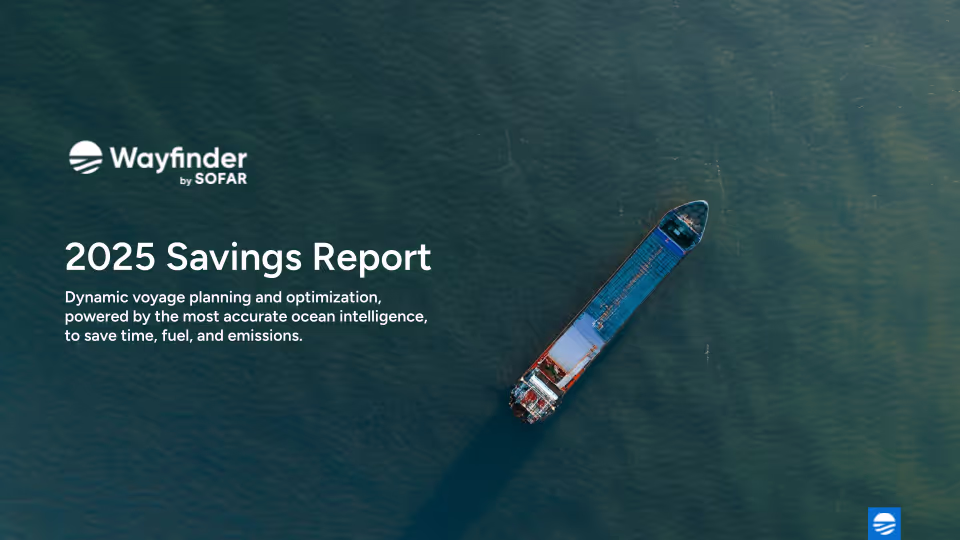
The results speak for themselves. As detailed in our 2025 Savings Report, Wayfinder delivered 6.9% average fuel savings per voyage across key global routes, up 1.4% year-over-year. Savings were consistent across every quarter: 7.0% in Q1, 6.7% in Q2, 6.7% in Q3, and 7.4% in Q4.
These figures are not cherry-picked from standout voyages in favorable weather windows, nor are they inflated by the faulty assumptions that weaken other methodologies. In fact, we’ve tested those alternative methods — they can easily double reported savings when it’s clear that’s not the case.
Wayfinder's reported gains reflect a science and data-driven methodology that measures optimization incrementally, day-by-day, in the real world as it evolves. Through geopolitical volatility, increasingly extreme weather, and regulatory uncertainty, we will continue to deliver strong savings, validated by rigorous methodology, to customers for years to come.
Interested in learning more about Wayfinder or our savings methodology? Connect with our team today.