
.jpg)
Chile's coastline runs more than 6,400 kilometers, almost entirely open to the Pacific. Roughly 98% of the country's imports and exports move by sea, which makes port operational windows not just a commercial concern but a national one. Few harbors offer natural protection from the storms that arrive from the north and northwest, and for the marine terminals that handle oil tankers, the question of whether conditions permit safe mooring is not academic. It determines whether fuel reaches the population.
That decision rests with Chile's port authority, a department of the Chilean Navy that regulates terminal operations across the country. When wave conditions approach the design parameters of a terminal, the authority closes the port. Until recently, the data behind that call was strikingly basic.
"Among other methods, the authority would send a young sailor to read a scale on the water," explains Fernando Landeta, civil engineer and founder of Skyring Marine. "If he saw one variation that exceeded the maximum parameter, the captain would close the port. And that process was updated three times a day."
In a country where many terminals operate with little protection from open ocean swell, three readings a day from a visual scale meant hours of unnecessary downtime every time conditions hovered near the threshold. For Skyring's clients, who include marine terminal operators in central and northern Chile, the operational cost of closures based on such limited data was substantial.
When a client at a maritime terminal in central Chile asked Skyring Marine to find a way to monitor waves in real time, Landeta had been weighing an ADCP. He had watched another operator on the same coast purchase one and never get it working. "They were never able to set it up and to make it work for three, four, five years," he recalls.
A colleague mentioned Spotter. The pitch made immediate sense. Real-time delivery solved the core problem with logger-based instruments, where a failure only becomes obvious when the unit is retrieved weeks or months later. There were no cables to run, no PC terminals to set up, and the Spotter Dashboard was usable by operators without specialist training. The economics fit a temporary project, and the small footprint suited a working terminal where deck space and vessel time are tight.
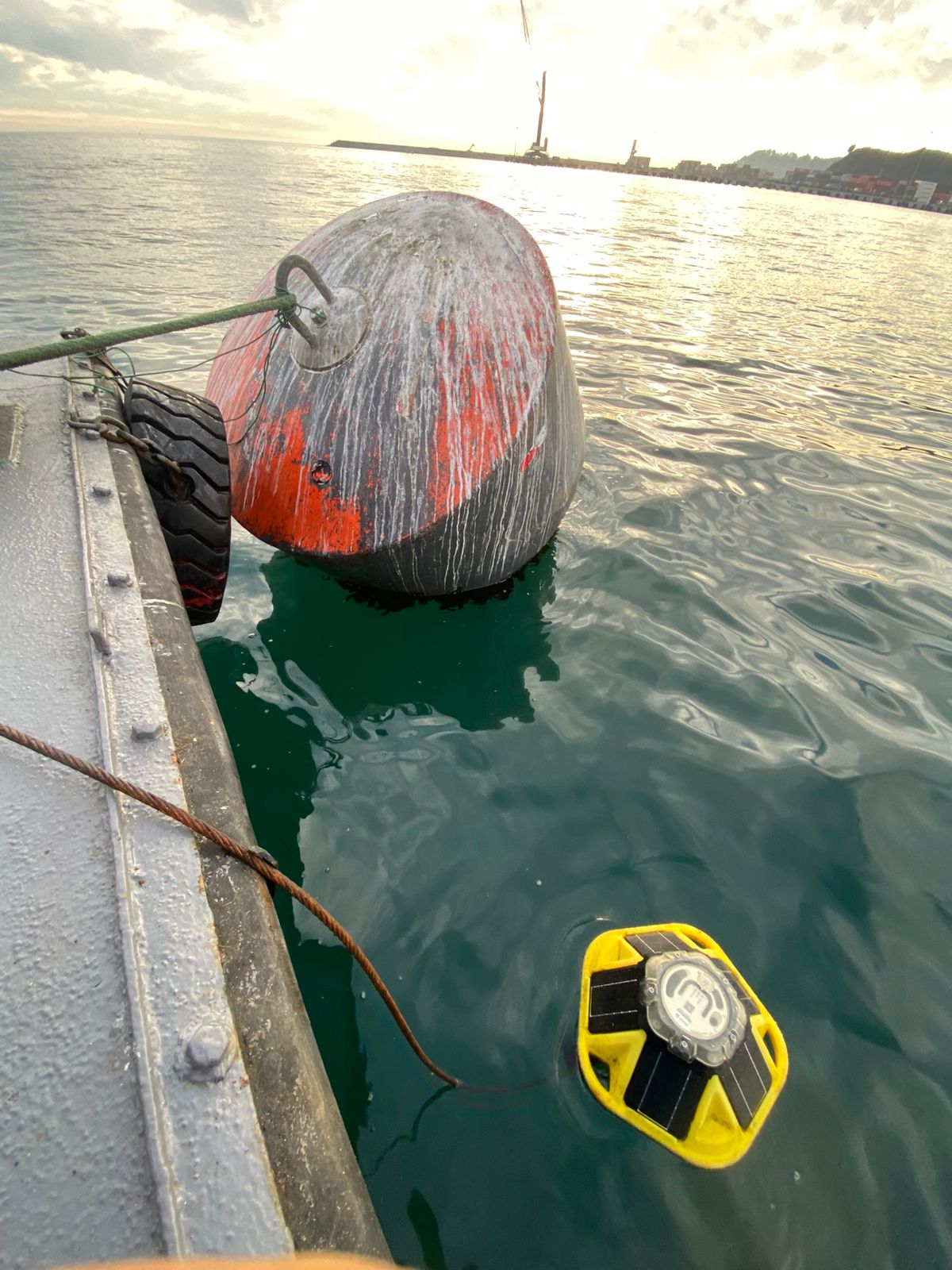
What started as a temporary deployment did not stay temporary for long.
The first Spotter quickly became a permanent fixture in the terminal's operational decisions. Within a year, Skyring was deploying a second unit at a related facility. Other clients followed. Spotter is now the default platform Skyring reaches for when a client needs reliable wave data presented in a form that operators and regulators can both understand.
"With proper maintenance, it has proven to be very reliable," Landeta says, "and the data is easy to present to the client."
The fleet has also grown beyond surface waves. At an oil terminal in northern Chile, the port authority required real-time wave and current measurements to support tanker operations. Skyring deployed a Smart Mooring unit pairing a Spotter with a current meter, delivering the integrated wave and current dataset the authority needed without the cabling and shore infrastructure of a traditional setup. A more recent project at a petrochemical terminal pairs a Spotter with an online oil spill monitor, designed to give the operator early warning of a spill so response can begin before pollutants reach the coast or wildlife. The integration is currently underway.For Landeta, the breadth of what the platform can deliver has been a quiet selling point as the fleet has grown. The same buoy that gives operators a clear go/no-go signal also produces wave spectra and the kind of detail an engineer needs for design work or post-event analysis.
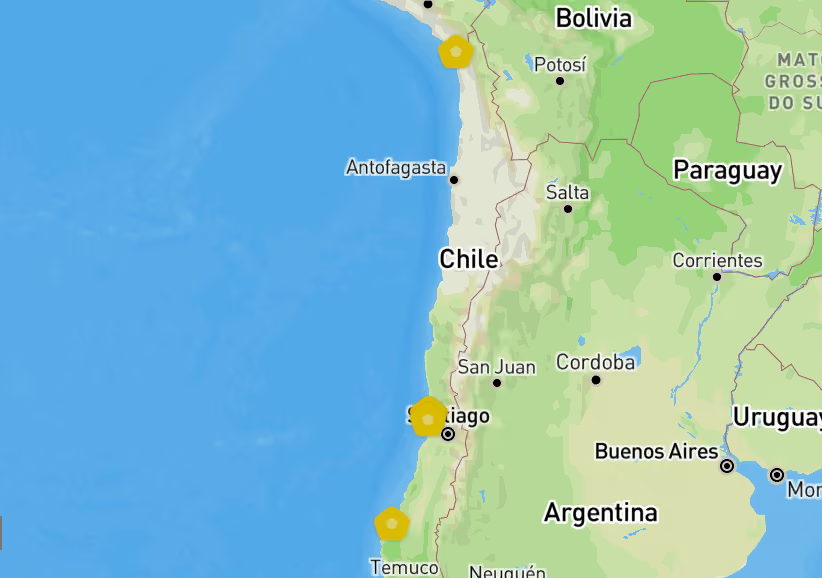
The most consequential change has been at the terminals themselves. Where the Navy once closed ports based on a sailor's reading updated three times a day, port authorities now look at live Spotter data delivered through the Spotter Dashboard. The result has been a measurable improvement in mooring statistics at terminals where Spotter is operating, and fewer hours lost to closures the data does not support.
"For particular mooring maneuvers of oil tanker ships coming to the maritime terminal, the wave information makes the operation possible," Landeta says. "It allows oil to get to the terminals, which is a critical asset for the population."
The investment, by Landeta's assessment, paid for itself within one to two years.
.jpg)
Skyring continues to expand the fleet as clients request additional sites, including the ongoing oil spill monitor integration at the petrochemical terminal. With each new request, the value proposition holds: a small platform that can be deployed quickly, a real-time dataset operators trust, and a presentation layer that closes the gap between scientific measurement and operational decision-making.
.avif)


