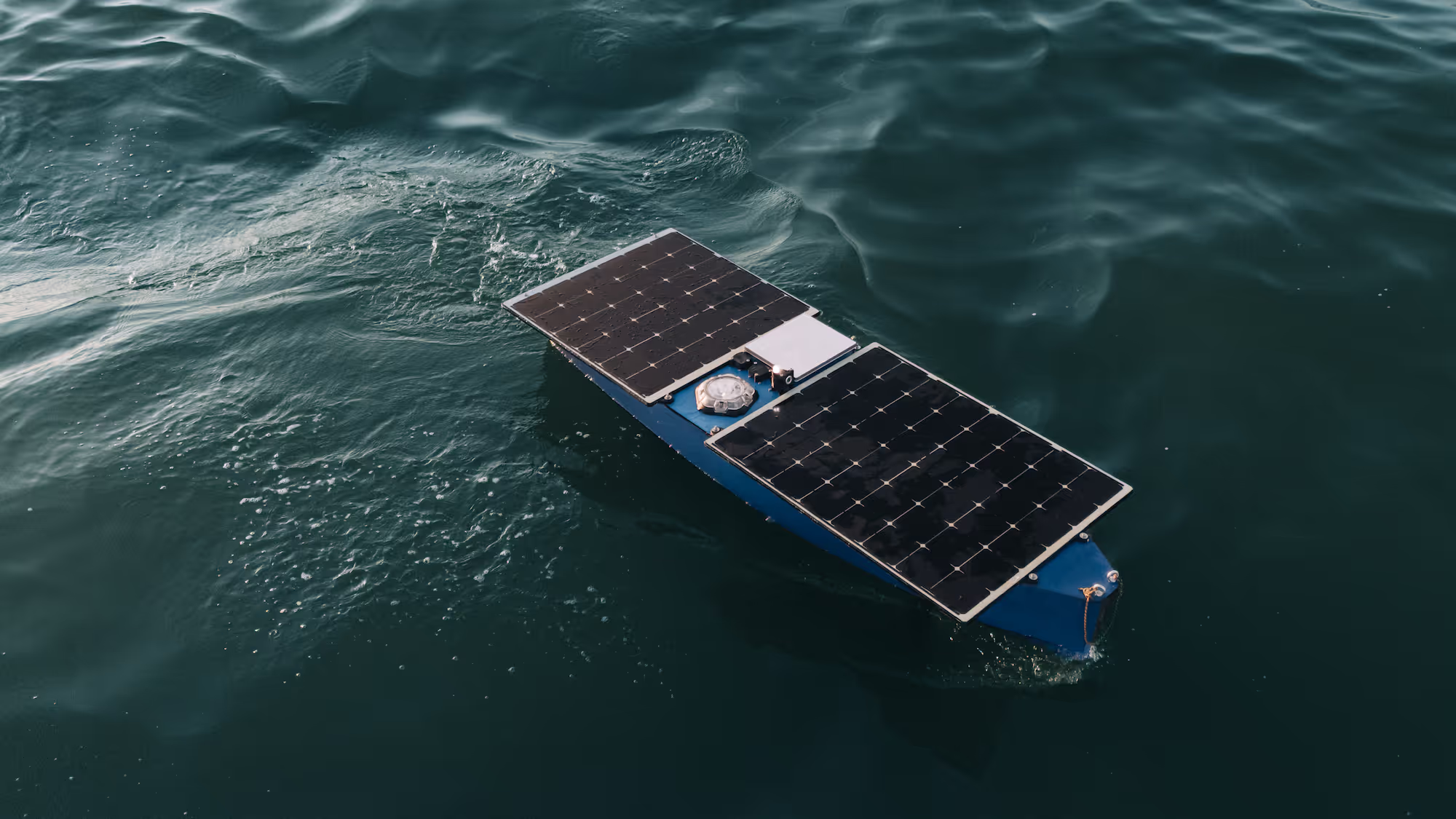

Spotter Scout, now in beta, is in the water, taking measurements in places where moored buoys can't go. Behind that simple-sounding capability sits a stack of decisions about how the vehicle's brain talks to its sensors, its motors, and the wider world. The most consequential of those decisions was teaching Bristlemouth — the open connectivity standard underneath the Spotter platform — to speak MAVLink.
This post is about why we made that choice, what it unlocks for Spotter Scout, and where we think it leads next.
MAVLink is a lightweight messaging protocol that the global drone community has settled on as the way to talk to autonomous vehicles. If you've ever sent a quadcopter to a waypoint from a ground control station, MAVLink was carrying the instructions. It's also the native language of the two most widely used open-source autopilot stacks: ArduPilot and PX4. In the aquatic world, both ArduRover (for surface vehicles) and ArduSub (for subsurface vehicles) are built on it, and companies like Blue Robotics have made it the de facto standard for crewless ocean platforms.
In short, if you're building a vehicle that drives itself, there's a very good chance it already speaks MAVLink.
Spotter Scout is a different kind of Spotter. A Spotter buoy is stationary or free drifting (moored in place or carried by the currents). Scout moves through the water under its own power. That means a flight controller, motors, an inertial measurement unit, a GPS — all the components you'd find in any autonomous platform — plus the wave, weather, and subsurface sensors that make a Spotter a Spotter. All of it needs to coexist on the same vehicle, and ideally on the same network.
MAVLink is the flight controller's native language. So the practical question was: do we run two parallel networks — one for vehicle control, one for sensing — or bring everything onto Bristlemouth?
We chose the latter: one network, less power, less complexity, and a single integration story for everything bolted to the vehicle.
MAVLink defines what gets said. It doesn't define how messages move. That's deliberate — MAVLink is transport-agnostic by design — but it leaves a real gap in marine deployments, where every milliwatt matters and you can't throw bandwidth at problems.
Bristlemouth fills that gap. It's a networking standard built for the realities of ocean platforms: simple long-run cabling, tight power budgets, and topologies that need to survive months of unattended operation. Rather than broadcasting MAVLink messages across the network and asking every node to decide whether to care, Bristlemouth routes each message directly to the component that needs it. A thruster controller only hears thruster messages. An IMU only hears IMU messages. Less traffic, lower latency, less power burned on irrelevant decoding.

Spotter Scout runs on solar power for months at a time, so every milliwatt the network doesn't burn on overhead is one available for propulsion, sensing, or staying on station longer.
For the engineers who want the architecture and API specifics, there's a technical write-up on the Bristlemouth community site.
The visible payoff is that Spotter Scout can do things a moored Spotter can't. It can transit to a site, hold station, drift through a feature of interest, and return on its own. It can extend coverage into water deeper than a mooring can practically reach, and it can do it without putting a boat and crew on the water for every deployment. Customers who previously had to choose between costly drifters and complex deepwater moorings now have a third option: send a Spotter.
The less visible payoff is that all of that happens on the same network as the science payload. The team that builds dashboards, exposes APIs, and integrates data from new sensors doesn't have to maintain a separate vehicle-side integration. Scout is, architecturally, a Spotter that drives.
The MAVLink integration was built for Spotter Scout, but the work reaches further. Any vehicle built on MAVLink — and that includes most of the USVs, ROVs, and research platforms in the water today — can now adopt Bristlemouth as its underlying network and gain what Scout gained: targeted message routing instead of broadcast, lower power overhead, and a single integration story across sensing and control. The integration is part of the open Bristlemouth project today, available to individual developers and commercial manufacturers alike.
Bristlemouth on its own is a connectivity layer for ocean sensing. With MAVLink, it can speak the language of the vehicles that move through the ocean, too.
Connect with us to learn more about Spotter Scout, Bristlemouth, and much more.