
.jpg)
Most underwater acoustic monitoring still works the way it did twenty years ago. A recorder goes in the water, sits there for months, gets recovered, and someone finds out what happened long after the moment to act on it has passed.
That is fine when the question is retrospective. It is not fine when the question is whether an unauthorized vessel entered the harbor on Tuesday night, whether pile driving crossed a permit threshold this morning, or whether there is a whale in the shipping lane right now.
Spotter Sound was built for the second kind of question. We launched it last year as a configuration of the Spotter Platform: a Spotter buoy, a Smart Mooring cable, and an AI-enabled hydrophone, sending acoustic data back in real time so teams can act while it still matters. This week we launched the next generation, with a meaningfully improved hydrophone at the center of it.
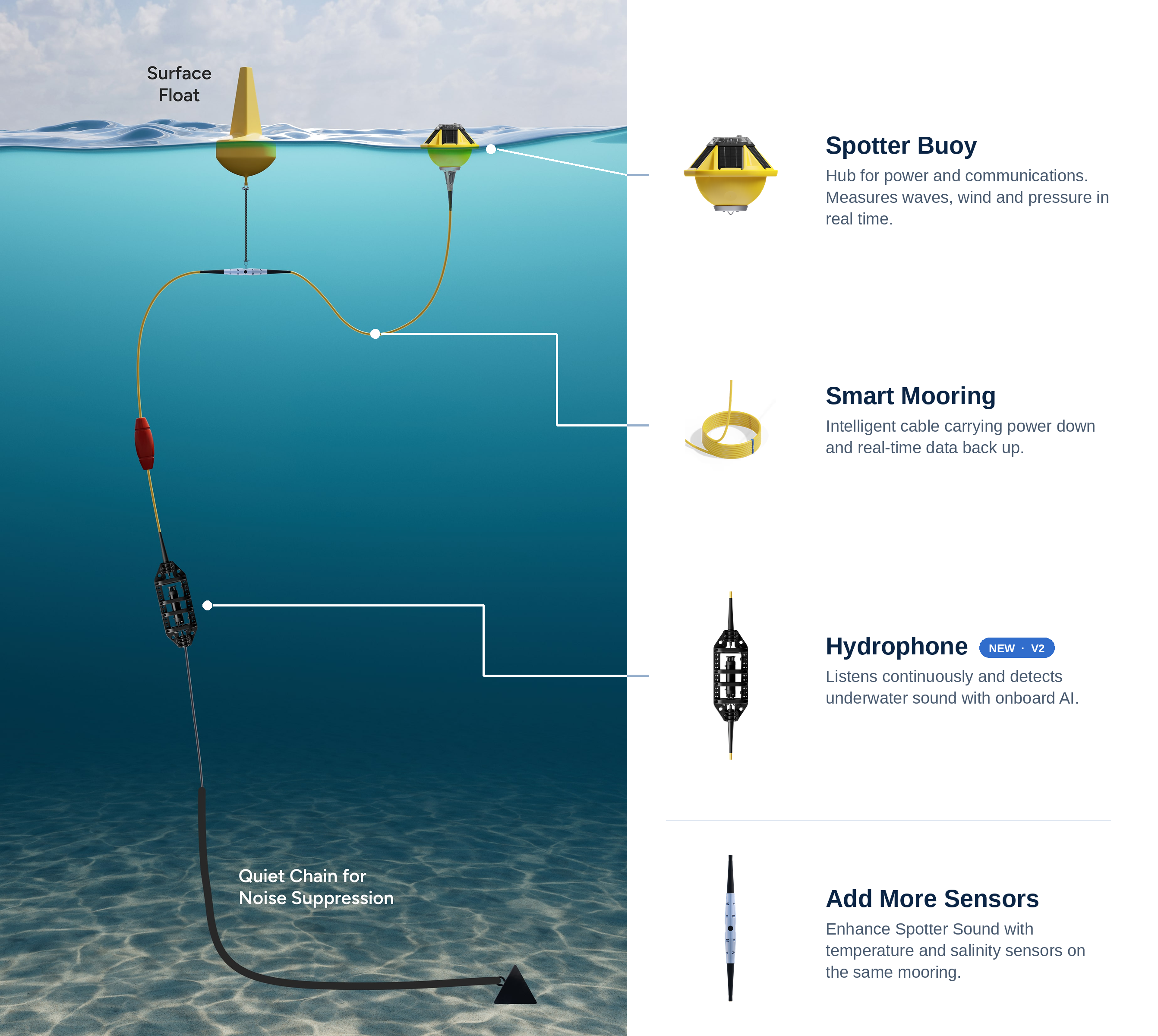
The Spotter buoy sits on the surface and handles power and communications, over both satellite and cellular, while collecting wave, wind, and surface met-ocean data of its own. It is solar-powered and recharges itself.
The Smart Mooring is the cable running down from it, and it is not just a tether. It passes power down to the sensors and data back up to the buoy, which is what makes real-time subsurface sensing possible from a buoy this size. It also includes our Quiet Chain, which keeps the mooring hardware from contaminating your recordings.
The AI-enabled hydrophone attaches to that cable at the depth you choose. It is Bristlemouth-native, which means it is genuinely plug-and-play: two cable connections and it starts reporting.
Because the mooring is a shared bus, you can add up to two more sensors alongside the hydrophone. Temperature and salinity are common additions, since water density shapes how sound propagates and knowing it makes your acoustic data more interpretable.
The whole assembly arrives configured and ready. Anyone who has deployed hydrophones knows that quieting your own mooring is a project in itself before you get anywhere near the science. Many years of those lessons are built into this ready-to-go system.
This is the headline, and it takes a minute of architecture to make sense.
The hydrophone has two brains. A very low-power microcontroller records continuously, writes to the SD card, and computes things like decade and octave band levels and energy detections, all while drawing a remarkably small amount of power. Alongside it sits a small Linux single-board computer, a Raspberry Pi Zero 2 W, which is what lets you run real detection models at the edge, whether that is the pre-loaded Hydrotwin algorithms or your own code.
In the first generation you could do both, but not at the same time indefinitely. The Linux computer drew more than the buoy could sustain continuously, so running models meant duty cycling, and duty cycling means gaps in the recording. The new generation solves this with an approach called time-late processing. The low-power side records continuously and never stops. The Linux side wakes on whatever duty cycle you set, works back through the stored data without interrupting the live recording, processes it, and sends its reports.
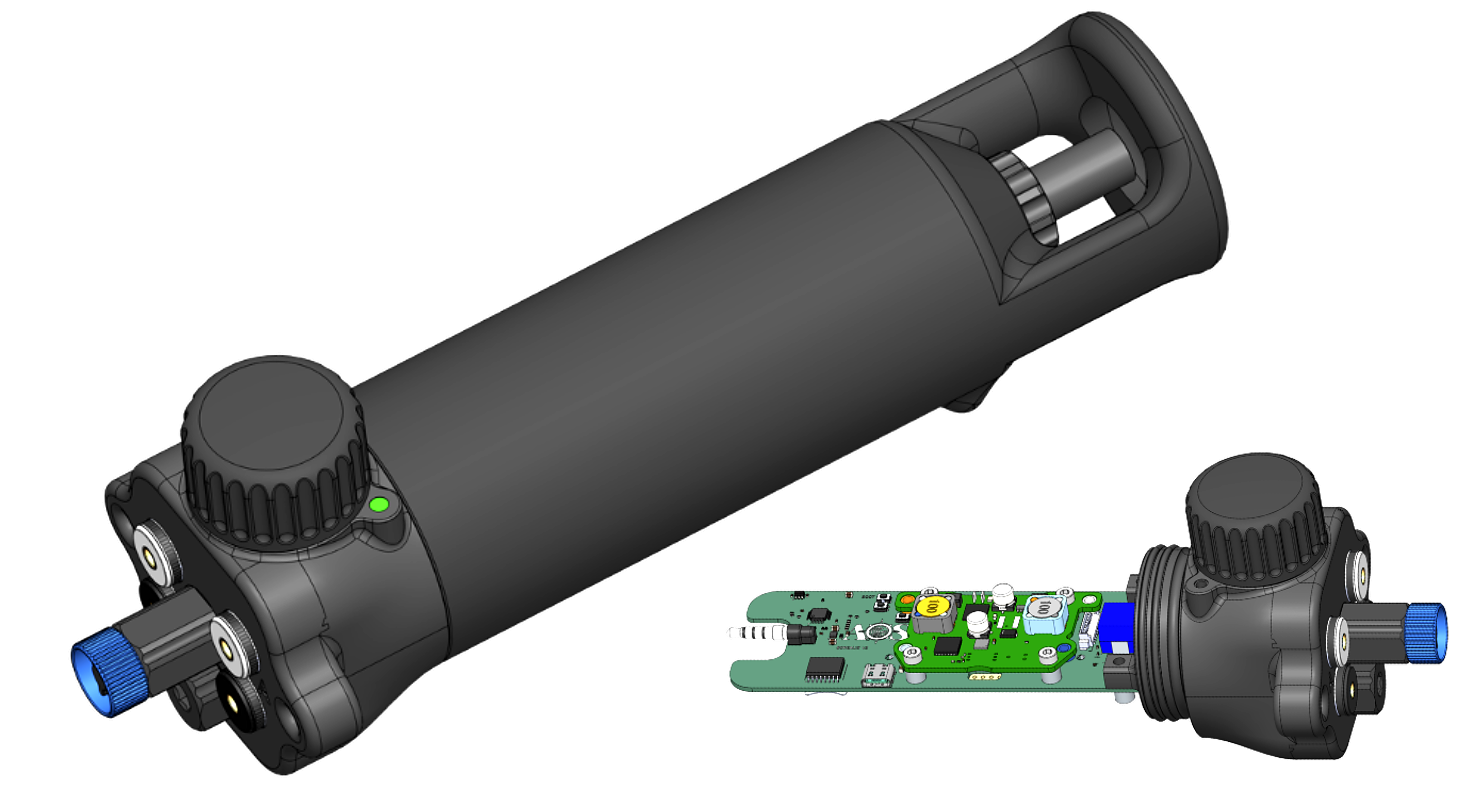
The practical result: 100 percent of the data can be processed, and the instrument records continuously rather than in windows.
Solar still depends on where and when you deploy. At high latitudes in winter, the power budget will not support every mode all the time, and you will make choices. The difference is that duty cycling is now a decision driven by your site and your mission rather than a limit built into the instrument. Where the sun cooperates, the hydrophone listens for as long as it is on station.
So what? Every detection use case depends on this. A hydrophone that listens 60 percent of the time misses 40 percent of what passes. For a port running pattern-of-life monitoring, the transit you miss is exactly the one that mattered, because an anomalous vessel is not obliged to arrive during your listening window. For an MPA team watching for unauthorized fishing in water nobody can patrol, gaps are the whole problem.
This generation carries a quieter electrical design and better sensitivity. System-induced noise sits directly on top of the signal you are trying to hear, so less of it means better detections at the margins.
The less obvious improvement is calibration discipline. An instrument built for one specific problem only needs to be good in the band that problem cares about, and can be relaxed about absolute levels and drift. An instrument meant to serve every application cannot be.
So what? For soundscape and ambient noise research, the measurement is the product, and a number you cannot trust is not a measurement. For marine construction, an exceedance record is a regulatory artifact. "Roughly 160 decibels" is not a defensible position when a permit limit is involved. This is the work that makes Spotter Sound appropriate for compliance monitoring and not just detection.
The case moved from aluminum to a polymer, which eliminates the galvanic corrosion you get when aluminum is strapped to steel. That polymer is also transparent to Wi-Fi, so you can enable the onboard Wi-Fi remotely and connect to the unit from the deck of a boat instead of fighting the enclosure. The SD card now pops out without opening the tube. And there is a flat spot on the housing, so it stops rolling around the deck of a RIB mid-deployment.
.png)
So what? Individually these are small. Together they are the difference between an instrument that feels like an engineering prototype and one that feels designed. A research team received one of the first new units the morning we launched. After about ten minutes of instruction, they turned it on, watched it start reporting, and deployed it from a research vessel. That is the intended experience.
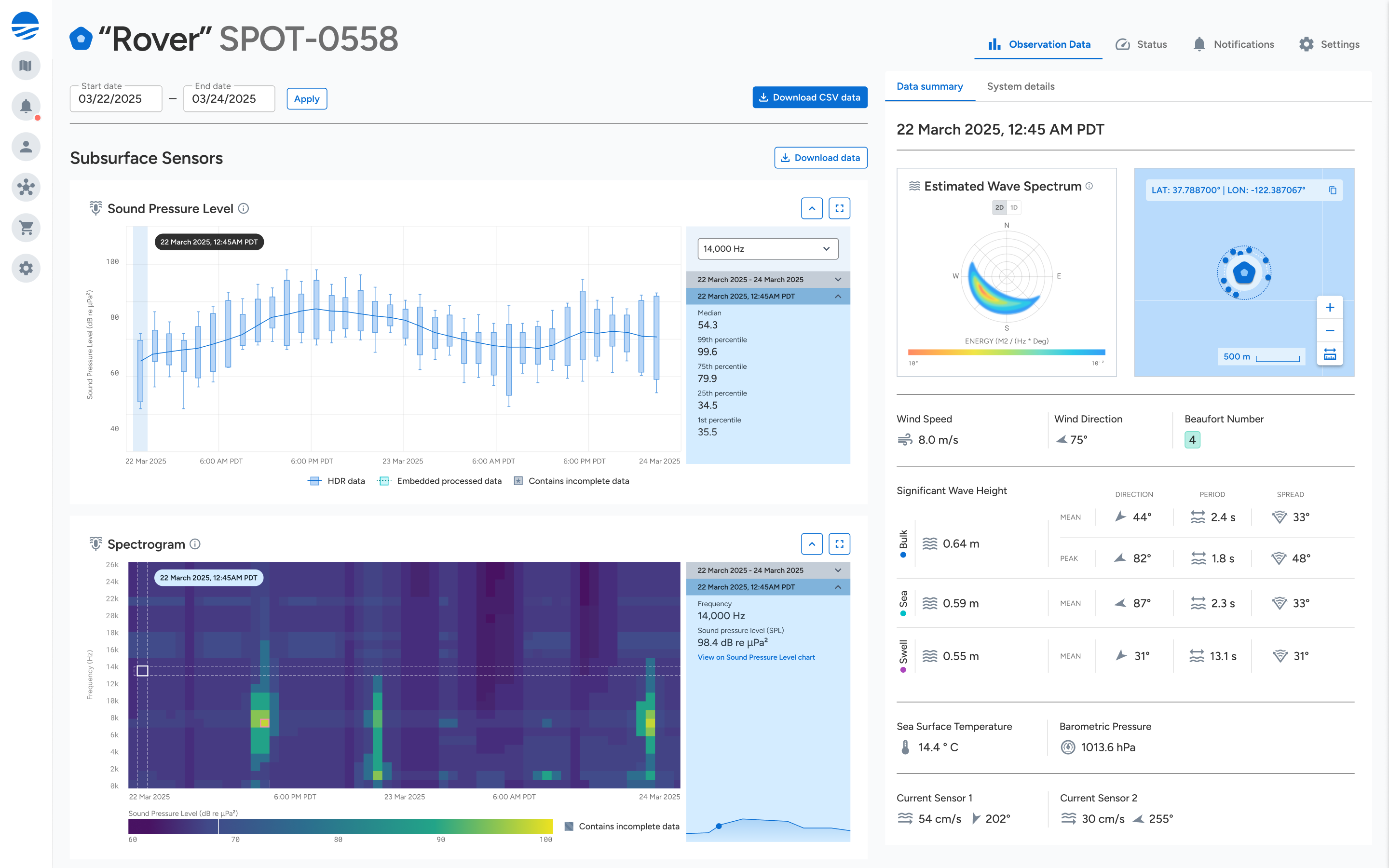
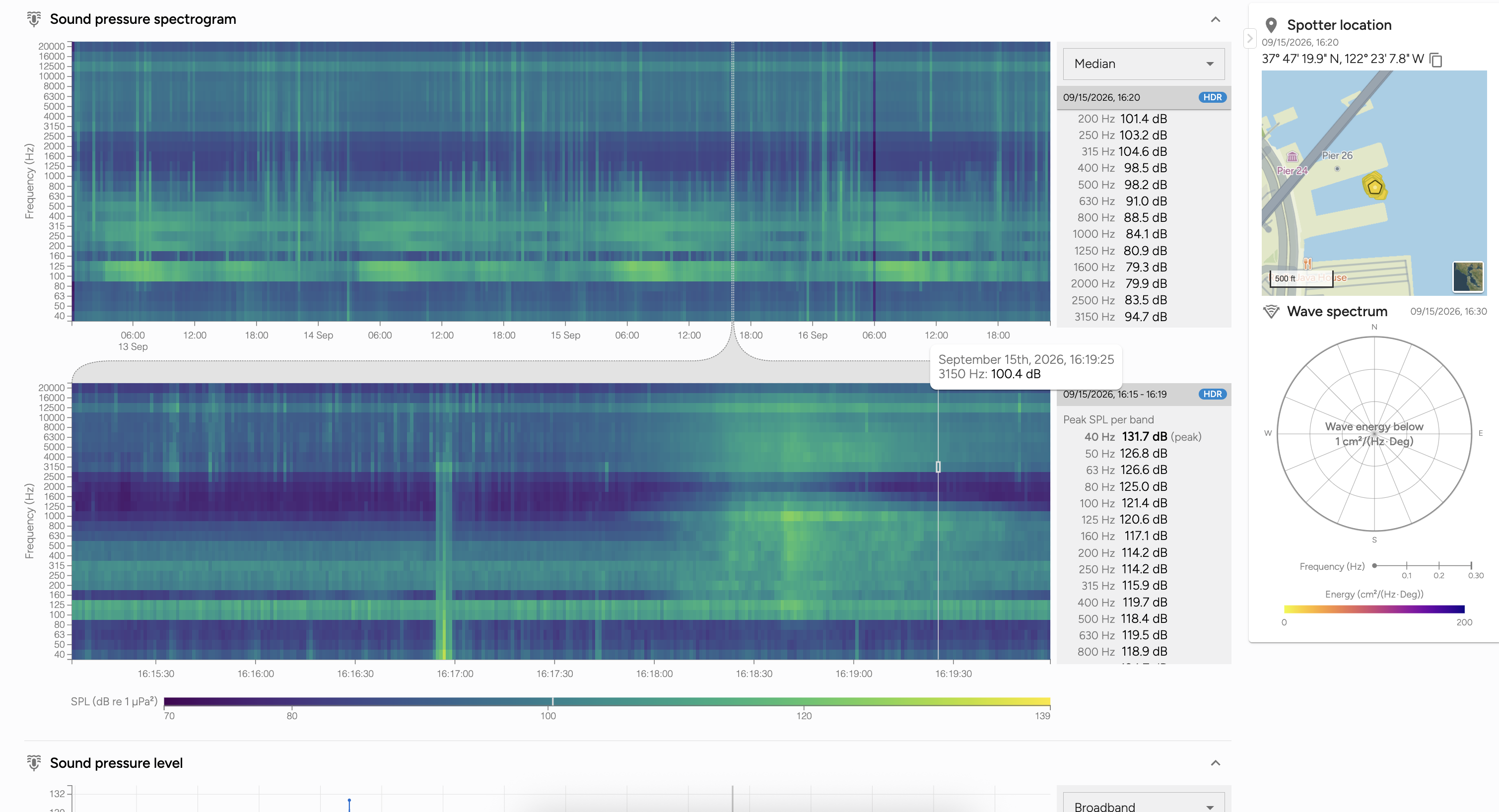
In the Spotter Dashboard, you get a rolling spectrogram averaged over the interval you choose. That view is built for patterns: the rhythm of a working port, the daily cycle of activity. Click into any interval and you get one-second resolution, where individual events live. A vessel that transits in ninety seconds can vanish into a longer average and shows up clearly at one second.
Alongside that you get sound pressure level and sound exposure level, plus threshold alerts you configure yourself. Set broadband SPL above the criterion in your permit and you get an email when it is crossed. For impact pile driving that is often 160 dB re 1 µPa rms, though the right criterion depends on your source type and your authorization. You also get the buoy's surface met-ocean data, so an acoustic event can be read against the sea state it happened in.
For customers running Hydrotwin, detections from onboard models surface in the dashboard as events you can click into, with the one-second spectrogram behind each one. A map view of those detections is rolling out now. This is where acoustics is heading for us: away from asking every user to read a spectrogram, toward telling them what happened. Teams who want to detect something specific, a particular marine mammal species or a particular class of vessel, can deploy their own models to the edge instead.
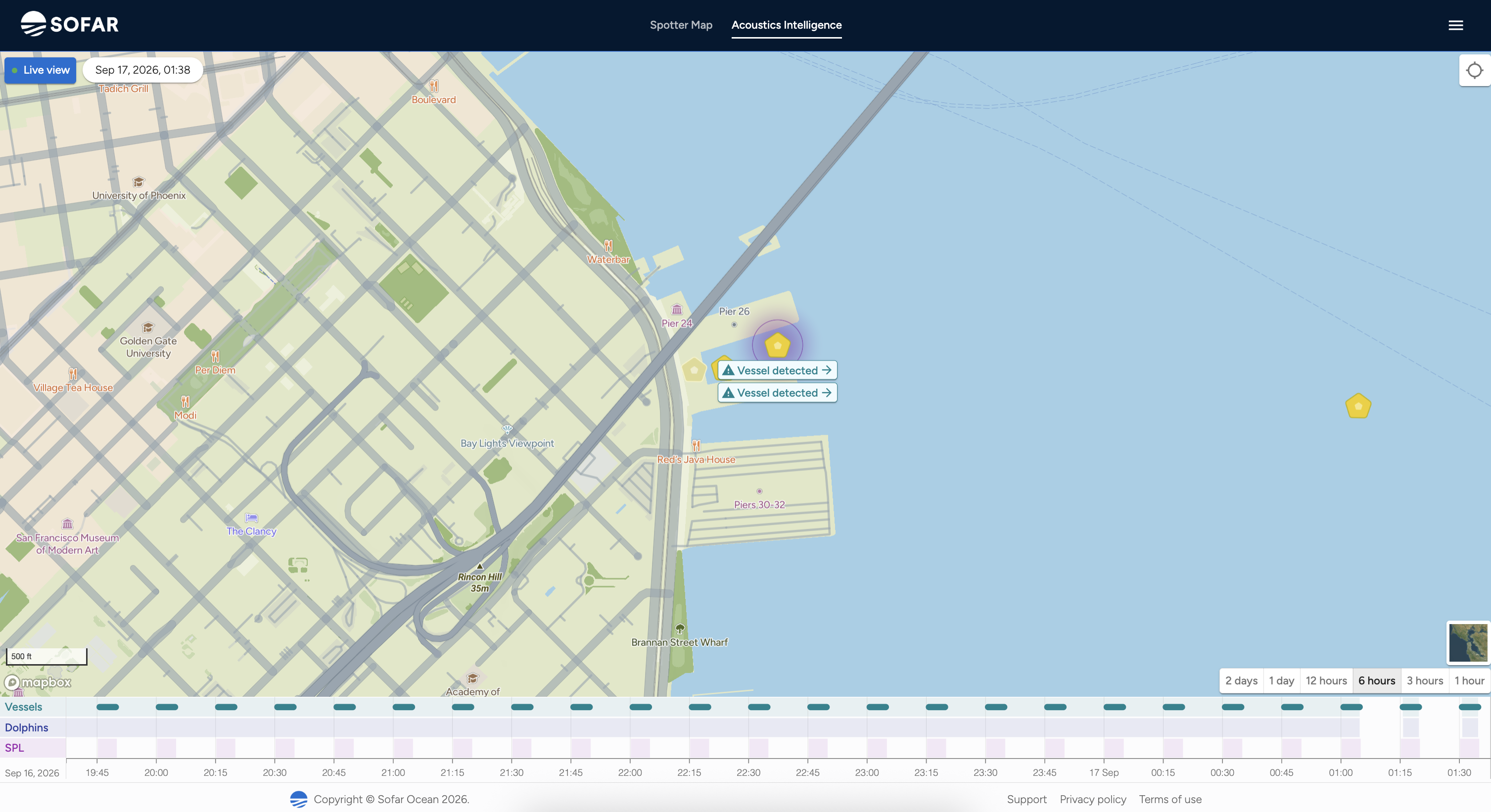
Everything in the dashboard is available through a standard REST API returning JSON, so teams can pull acoustic data into systems they already use. Full raw audio lives on the SD card, retrieved with the unit or by swapping the card in the field.
This is not the most sensitive hydrophone in the world, and it is not a specialized array built for one narrow problem. It was designed to be affordable, extremely low power, rugged, genuinely usable, and very good across a wide range of missions rather than exceptional at one.
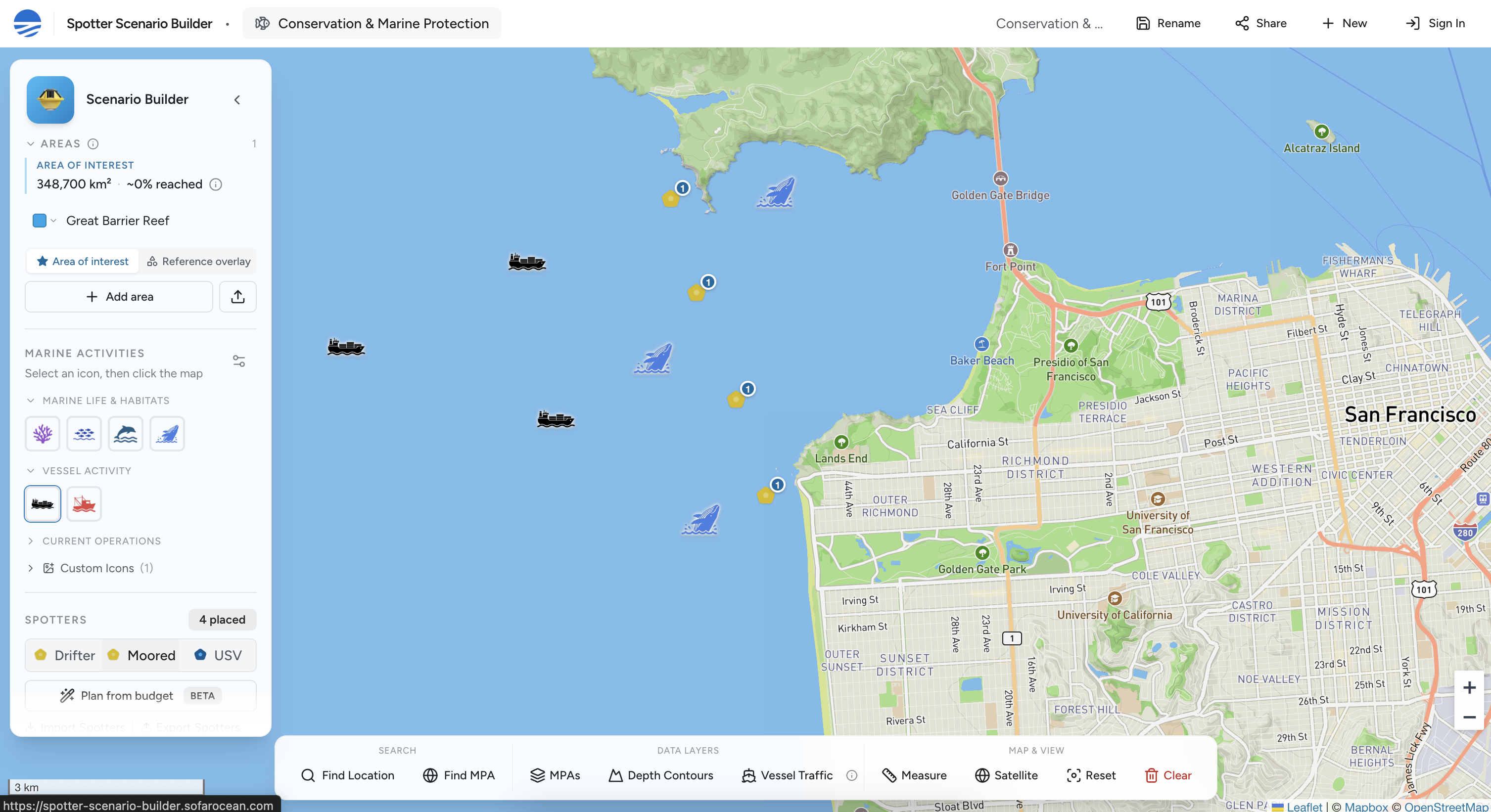
That tradeoff is deliberate, and the reason for it is coverage. One exquisite instrument gives you one point in the ocean, and acoustic questions are spatial: where did it come from, which way is it heading, is this area quieter than that one. When a single system costs what Spotter Sound costs, a network stops being a proposal you cannot fund.
On detection range, the only honest answer is that it depends, on frequency, bottom type, sound speed profile, and ambient noise. In test deployments by the team that builds the hydrophone, large commercial vessels were detected around 40 kilometers out on the Coronado Bank off San Diego. Under genuinely difficult conditions, a crowded port with a sound-absorbing bottom in heavy weather, expect hundreds of meters. Most sites sit somewhere in between.
The hydrophone is built by Applied Ocean Sciences, and their development roadmap runs through the next year and a half. A multi-channel version with four or eight channels in a single package is targeted for the spring, which would open up beamforming and directionality at the edge. An active variant that can transmit as well as receive, making it a hub for underwater acoustic communications, is targeted for late next year. A more compact version for smaller platforms may arrive considerably sooner.
90 first-generation units are in the water today, gathering the feedback that shaped this release, and the first production units of the new generation shipped this week.
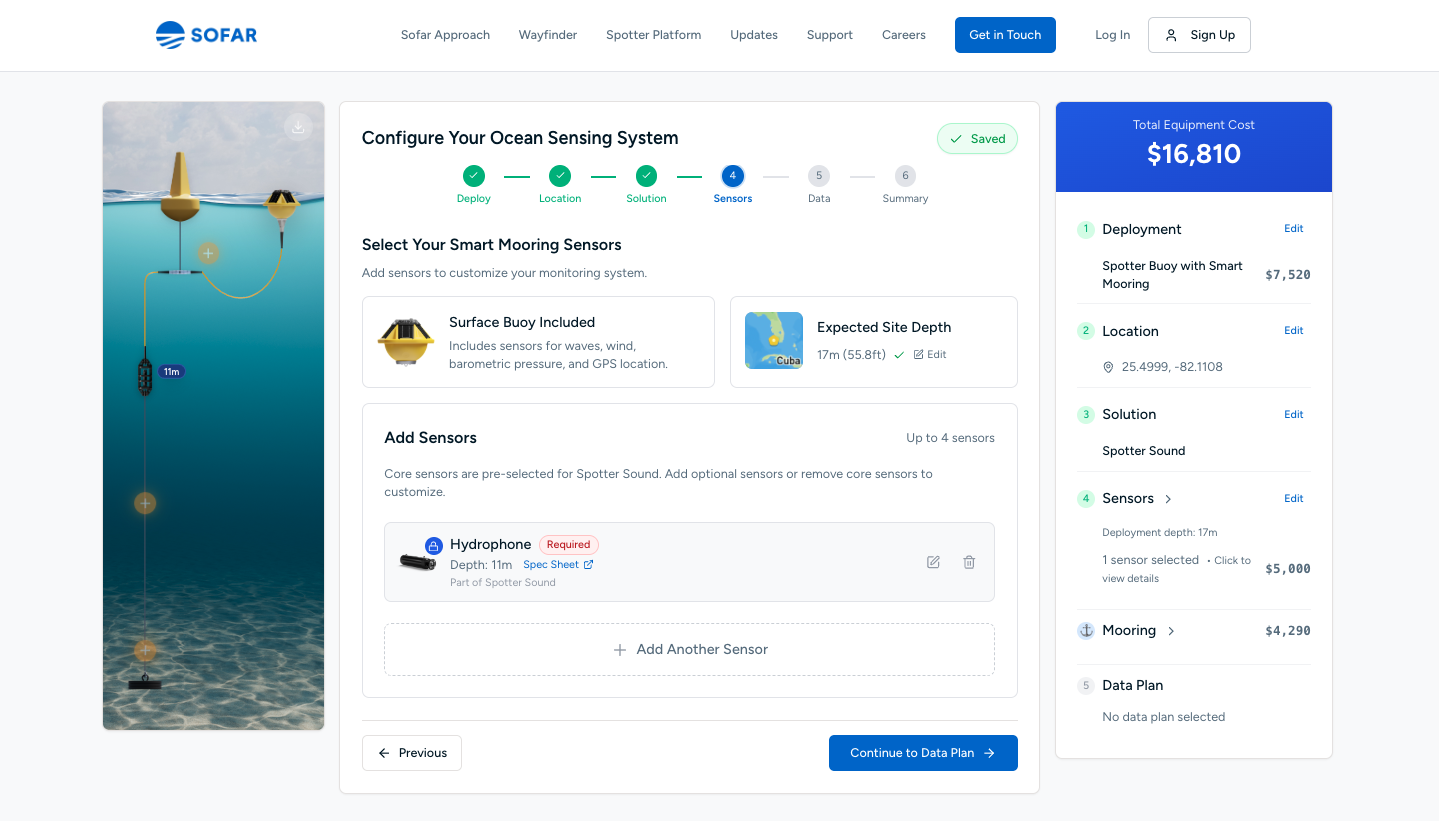
The Spotter Configurator lets you build a Spotter Sound system, set your depth and location, add sensors, and see the full price including every mooring component, without talking to anyone first. If you are thinking about coverage across a port, a protected area, or a work site, the Spotter Scenario Builder helps you design a network and understand the density you need.
We also went deeper on all of this in our recent launch webinar, including a live walkthrough of acoustic data in the dashboard and a long Q&A.
If you want to talk through a specific deployment, get in touch.


