

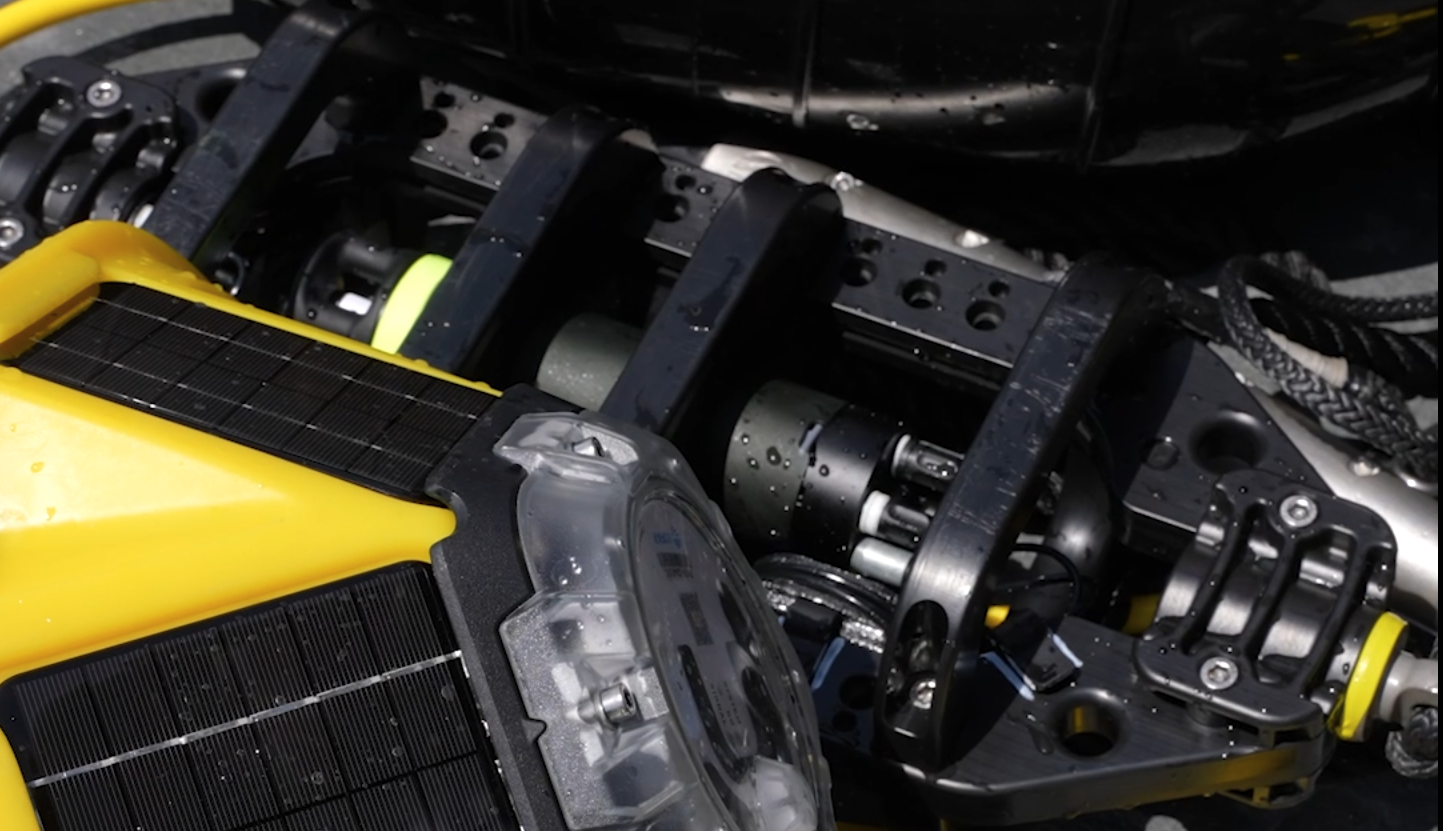
Spotter Sound listens to the ocean and tells you what it hears. A hydrophone hangs below a Spotter buoy, and a small onboard computer runs AI models that detect vessels and dolphins as they pass. Doing that around the clock, on a buoy powered only by the sun, is a power budget problem before it is anything else.
With the second generation of Spotter Sound, built with our partners at Applied Ocean Sciences (AOS), we cut the hydrophone's draw with detection running from 960 mW to 360 mW. That 600 mW came from three places: new hardware, a leaner computer, and a smarter schedule for when that computer is allowed to be awake. This post walks through each one and what it unlocked. For the full spec rundown, see my announcement on the Bristlemouth forum.
Spotter runs on solar panels and a battery. In winter, and the farther you go from the equator, the days get shorter and the sun sits lower, so the panels harvest less. A payload can only stay on year-round where the panels can keep up with it in the darkest month.
Gen 1 of Spotter Sound showed that onboard acoustic detection works at sea. Running that detection continuously, all year, is a much harder power problem, and at 960 mW with detection on, it was the natural next frontier. So when we started Gen 2, the goal we heard over and over was simple: run continuously, all year, anywhere within 40° north or south.
The system has three processing elements, and each one had a role to play in hitting that number:
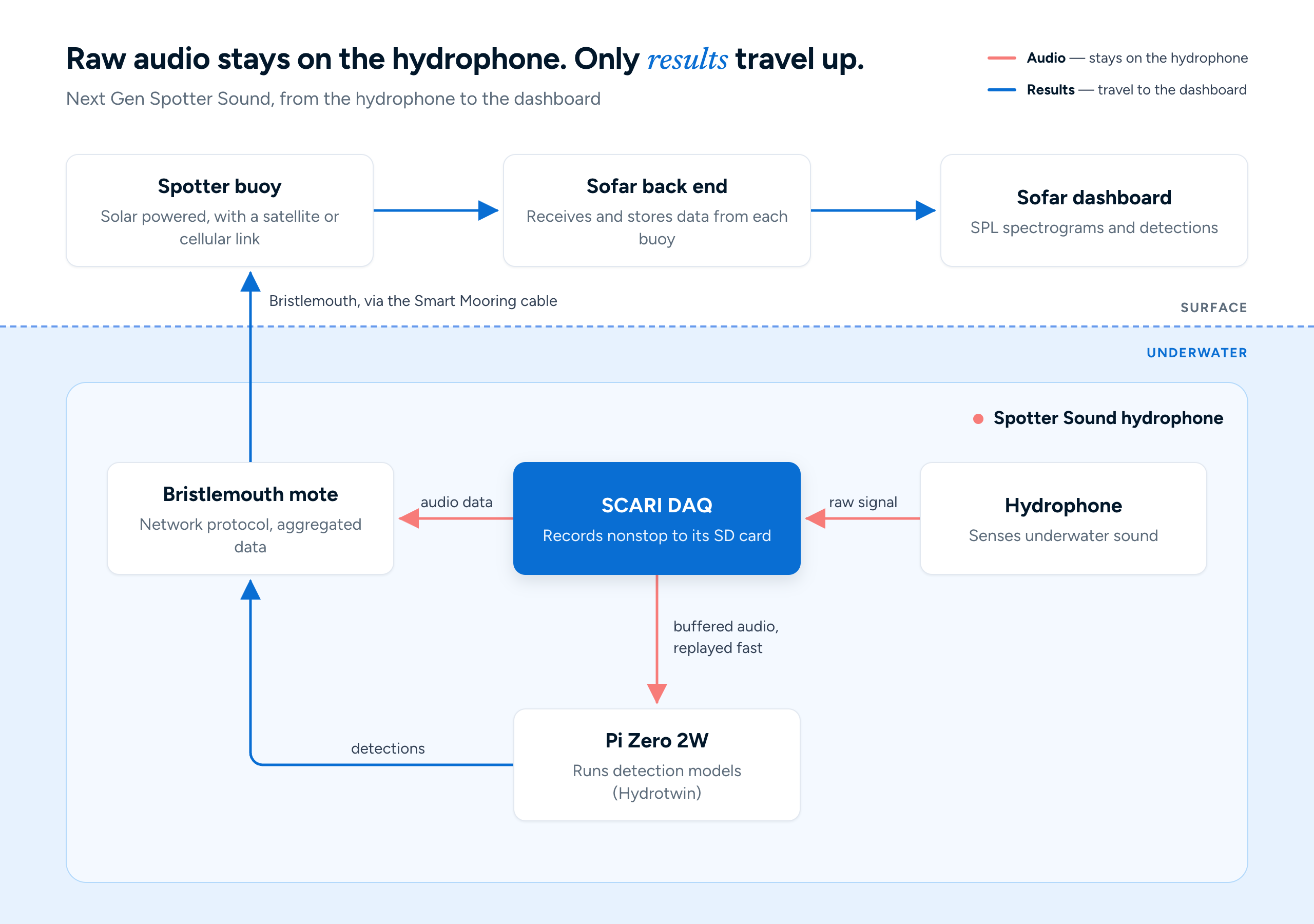
AOS rebuilt the SCARI DAQ board from the ground up. The biggest change was the microcontroller. Gen 1 used a Microchip ATSAMD51, and Gen 2 moves to a Raspberry Pi RP2350: a dual-core Arm Cortex-M33 with 520 kB of RAM, up from 256 kB.
AOS also cut the number of components on the board, especially power supplies. Every time you step voltage up or down you lose a little energy, so fewer conversion stages means less waste. On top of that, they wrote new sampling algorithms that do the same acquisition work for less power.
Together, those changes saved about 40 mW. That may not sound like much, but on a solar budget it's significant. With the SBC off, the hydrophone dropped from 180 mW to 140 mW. We weren't expecting much from a hardware change alone. The new processor draws less power and gives us a second core, so getting both was a huge win.
The Pi Zero 2W is by far the biggest power draw in the system, so it's where the largest savings were hiding. At sea it runs headless: no monitor, no keyboard, no mouse, just a model running autonomously on a stream of audio. A stock Linux image doesn't know that, and it keeps powering hardware the buoy will never use.
So we turned things off:
In early tests, those changes took the Pi from about 760 mW to about 390 mW while it ran a detection model. The Linux image improvements are open source in the borealis_sbc repository if you want to build on them.
The biggest single gain came from a simple idea: the Pi doesn't have to be awake to hear everything. The SCARI DAQ is the part that listens, and it never stops. It records continuously to its SD card whether the Pi is on or off.
Gen 2 adds a duty cycle built on that. In each 30-minute window, the Pi sleeps for the first 25 minutes. For the last 5, it boots, and the DAQ replays the buffered audio to it faster than real time. The detection models see every second of the 30 minutes, including the stretch when the Pi was off. How much faster than real time? In one of our test runs, even with the Pi's processor throttled to 600 MHz, it worked through 30 minutes of audio in about 160 seconds. The Pi now runs about a sixth of the time, and the data record has no gaps.
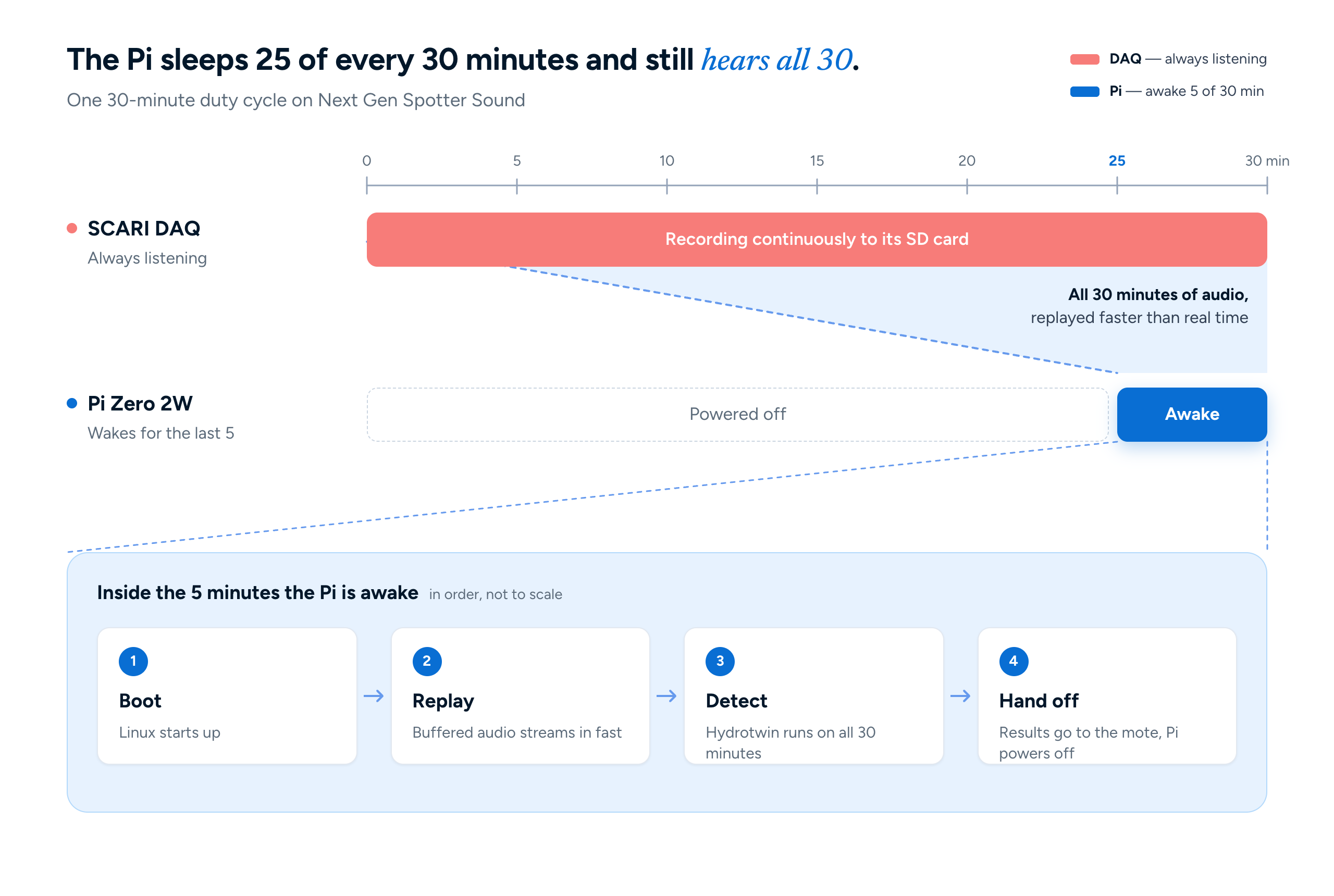
There's a tradeoff in choosing the interval. Every wake-up means booting Linux, and a boot costs energy no matter how short the work that follows. We've put a lot of effort into cutting boot time, but it's still overhead. A shorter interval means more boots per day and more power spent on them. A longer one saves more, but detections arrive less often. We settled on 30 minutes as the production default.
Added together, the three levers cut about 600 mW from the hydrophone's draw with detection running. Hardware accounts for about 140 mW, and the SBC duty cycling accounts for the rest.
One note on reading these numbers: the table shows what the hydrophone itself draws. The solar panels have to cover the whole system, including the Spotter buoy, the Smart Mooring, and conversion losses along the way. All in, that comes to about 430 mW with detection off and about 720 mW with it on.
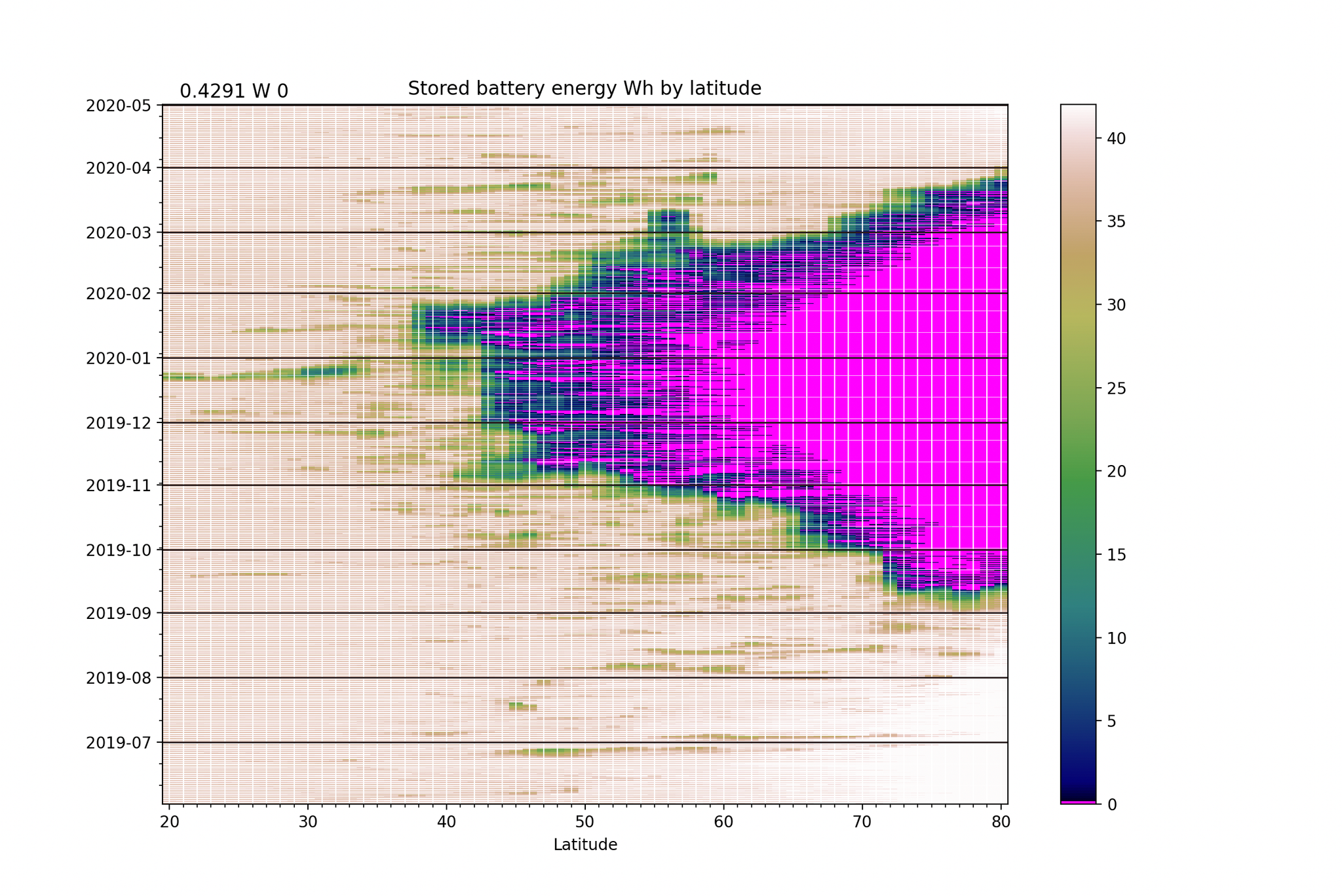
With the Pi off, Gen 2 meets the 40° goal. With detection running all year, it now works anywhere within 20° of the equator. Closing the gap to 40° with detection on is the next job.
We're not done. The team is still chasing milliwatts, and a few directions look promising:
In the meantime, Gen 2 is available now. It brings AI detection of vessels and dolphins, real-time sound pressure level (SPL) spectrograms in the Sofar dashboard, and better audio quality and sensitivity than Gen 1.
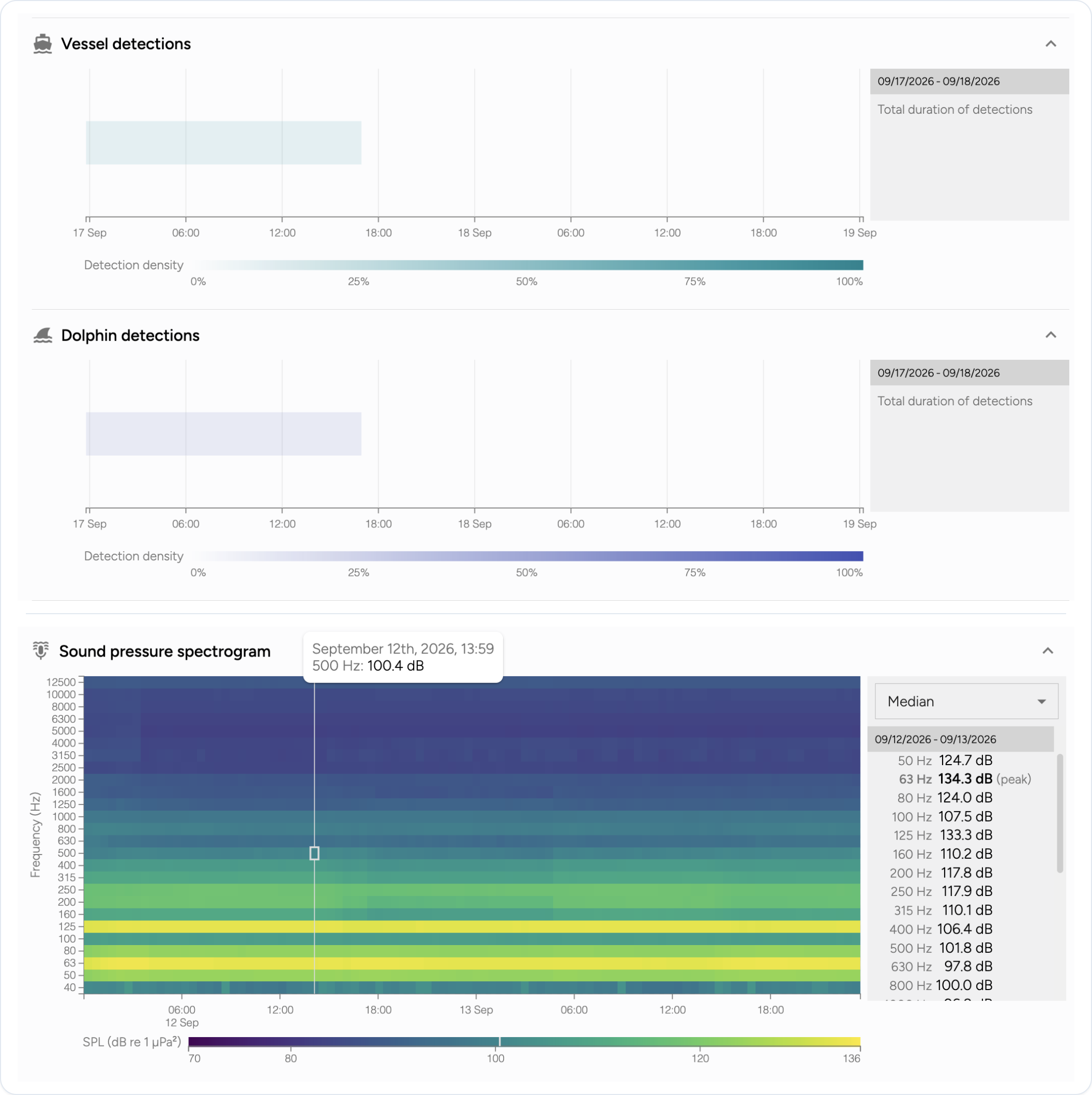
On a solar-powered buoy, every milliwatt counts. We went after savings everywhere we could find them: the board, the operating system, and the schedule for when the computer is even allowed to be on. If you're building on Bristlemouth, the borealis_sbc repo and the forum thread are good places to start. To see what Spotter Sound can do for your work, learn more about Spotter Sound.
.png)
.jpg)
