.png)

A charterer fixes a vessel on Tuesday afternoon. Cargo is waiting, laycan is tight, and the vessel sets sail on Wednesday morning. Within those few hours, the charterer needs to plan the voyage for a vessel they may never have operated before, with limited performance data, no relationship with the master, and no time for a lengthy onboarding process.
That creates a difficult problem: How do you optimize a voyage accurately when you know relatively little about the vessel?
Most of the market attempts to solve this the same way. Send the ship’s IMO number and the charterparty to whichever provider can turn it around quickest. What comes back is usually speed-based guidance set to the charterparty terms. The guidance is not optimized, and it cannot be.
We’ve never been comfortable with that. Over the last few months, we’ve shipped new improvements to close that gap for newly fixed vessels.
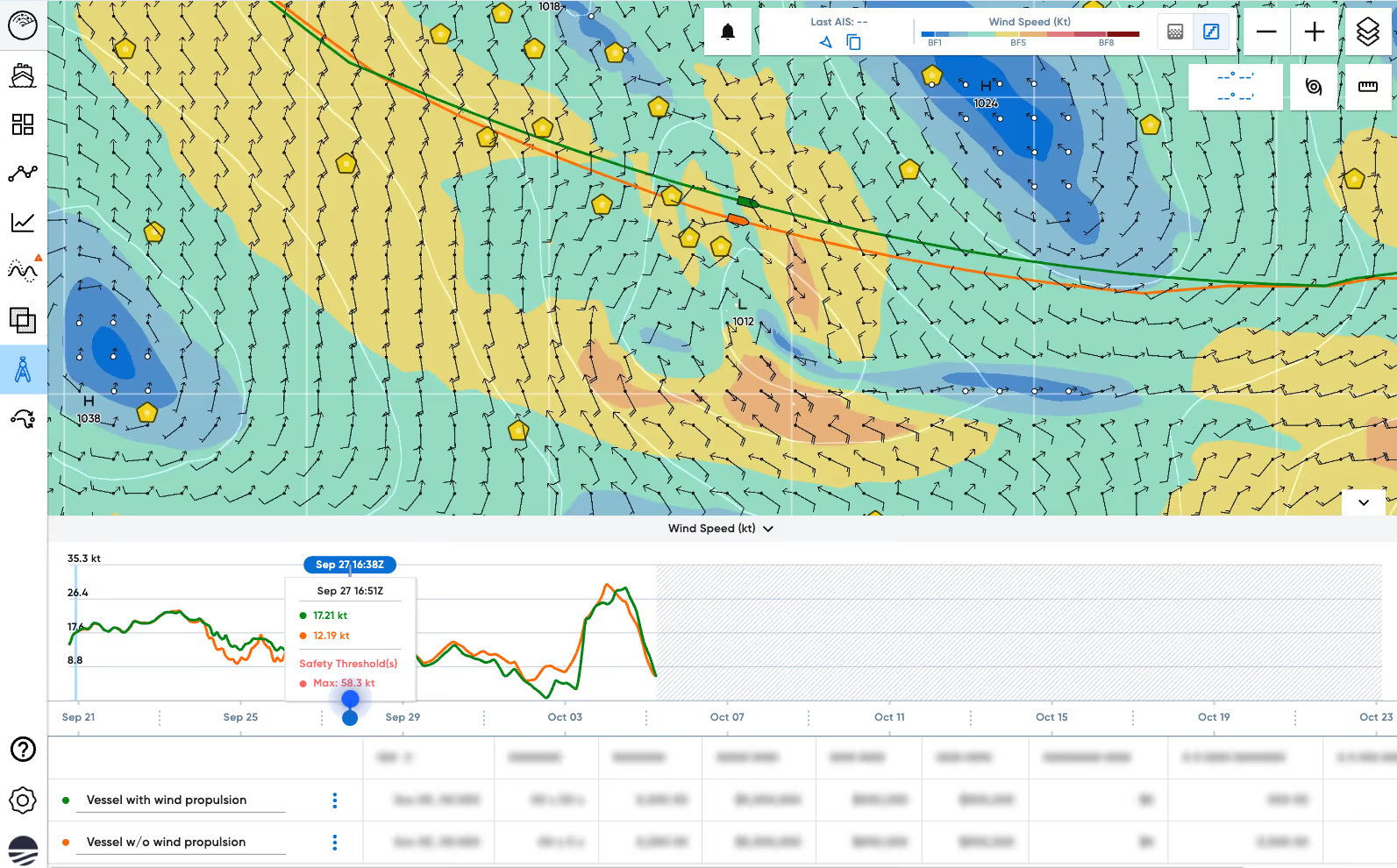
Wayfinder delivers dynamic voyage optimization, powered by the most accurate marine weather and a vessel-specific performance model. Our vessel performance models represent a true physics model of how a specific hull and propeller convert fuel into speed as the vessel experiences weather resistance. Our performance models are uniquely calibrated for each ship and built from observed behavior. However, a vessel fixed yesterday has no observed behavior yet.
How accurate can our vessel performance models be when we have no observations for a specific vessel? We call this Day Zero Accuracy.
The standard industry answer to this problem is a “class average.” Take every vessel of that size and type, average their performance, and use it as the starting guess. Wait for noon reports, then recalibrate to the specific vessel. The problem is variance. Two vessels of the same size and type can perform very differently, so the average describes neither of them well.
Those first days matter most to a charterer. They are still learning whether the vessel performs as fixed. Choosing which route to send the master is hardest when the model knows least.
A physics model needs data. Onboarding a vessel properly commonly means a 50-question technical survey covering hull, propeller, and drivetrain. With enough time, an owner can usually produce those answers. However, it’s not usually quick enough to be useful for a charterer fixing a spot voyage.
The obvious shortcut is to look the vessel up. We tried that by evaluating the major commercial vessel databases against what we actually need. It wasn’t good enough. Public and vendor sources are typically broad, stale, or silent on characteristics that govern performance. We realized that we needed to relax our data requirements without relaxing our accuracy requirements.
The reason that matters more for us than for a conventional weather router comes down to how our model works. Wayfinder does not fit a statistical curve to past voyages. Our high-accuracy VPMs result from running a force-balancing physical simulation. We combine the core of a physics-backed simulation with a vessel-specific machine learning model. That is what enables the model to extrapolate into weather it has never seen, and to be interrogated for the use of optimization rather than merely relying on historic data.
So, we stopped treating missing values as blanks and started treating them as questions with derivable answers. Where a value is unknown, Wayfinder derives it. Not just with a plain average, we use machine learning to determine which vessel characteristics are high confidence vs low confidence, and then further derive the low confidence values from the high confidence values across our fleet.
That means you only need to confirm a short set of vessel particulars at onboarding. Wayfinder derives the rest, including drivetrain and propeller dimensions.
A draft-to-displacement relationship enables us to turn a single measurement of “draft” into a usable estimate of loaded volume.
That relationship used to come from class averages built on mixed data sources of uneven quality, but the result doesn’t hold up across vessels.
The fix was to leverage the high-confidence dimensions and derive a block coefficient, and use that dimensionless figure to back-calculate a more stable draft-to-displacement estimate.
We saw a 3× improvement in the accuracy of the draft-to-displacement relationship on Day Zero, and it enabled us to remove even more information from the onboarding form.
The third improvement is to ensure that when we get a good idea of the vessel in one load condition, we can extrapolate that accuracy to the other load condition as well.
A vessel’s first voyage on Wayfinder teaches us about one load condition. Calibration now carries what we learn across to the other one, so accuracy doesn’t drop away when the cargo changes.
The result for charterers: It doesn’t matter whether your first voyage on Wayfinder is laden or ballast. The next one is modeled just as well.
We know that every voyage represents a costly decision for our charterers that has to be actively renegotiated as the weather evolves: what routes to choose? What speeds to go?
Wayfinder resolves these trade-offs explicitly and returns an RPM the master can hold, rather than a speed the ship cannot realistically keep.
That calculation is only ever as good as the physical simulation underpinning it. The optimizer is asking, in effect, what does the next tenth of a knot cost in fuel, and is it worth the hours it saves?
The vessel performance model answers those questions at every step. A model that misjudges consumption answers that question confidently and wrongly. The optimizer then returns an RPM that isn’t the cheapest one available.
Sharpening the model moves the recommended RPM closer to the true optimum on every leg. The saving on one voyage can be small. Across a year of fixtures, it isn’t.
Contact the Wayfinder team for a demo, or read more about how the Wayfinder VPM works here.