The world's oceans are under unprecedented pressure.1 Climate change, overfishing, pollution, and habitat destruction threaten marine ecosystems that billions of people depend on for food, livelihoods, and cultural identity.2
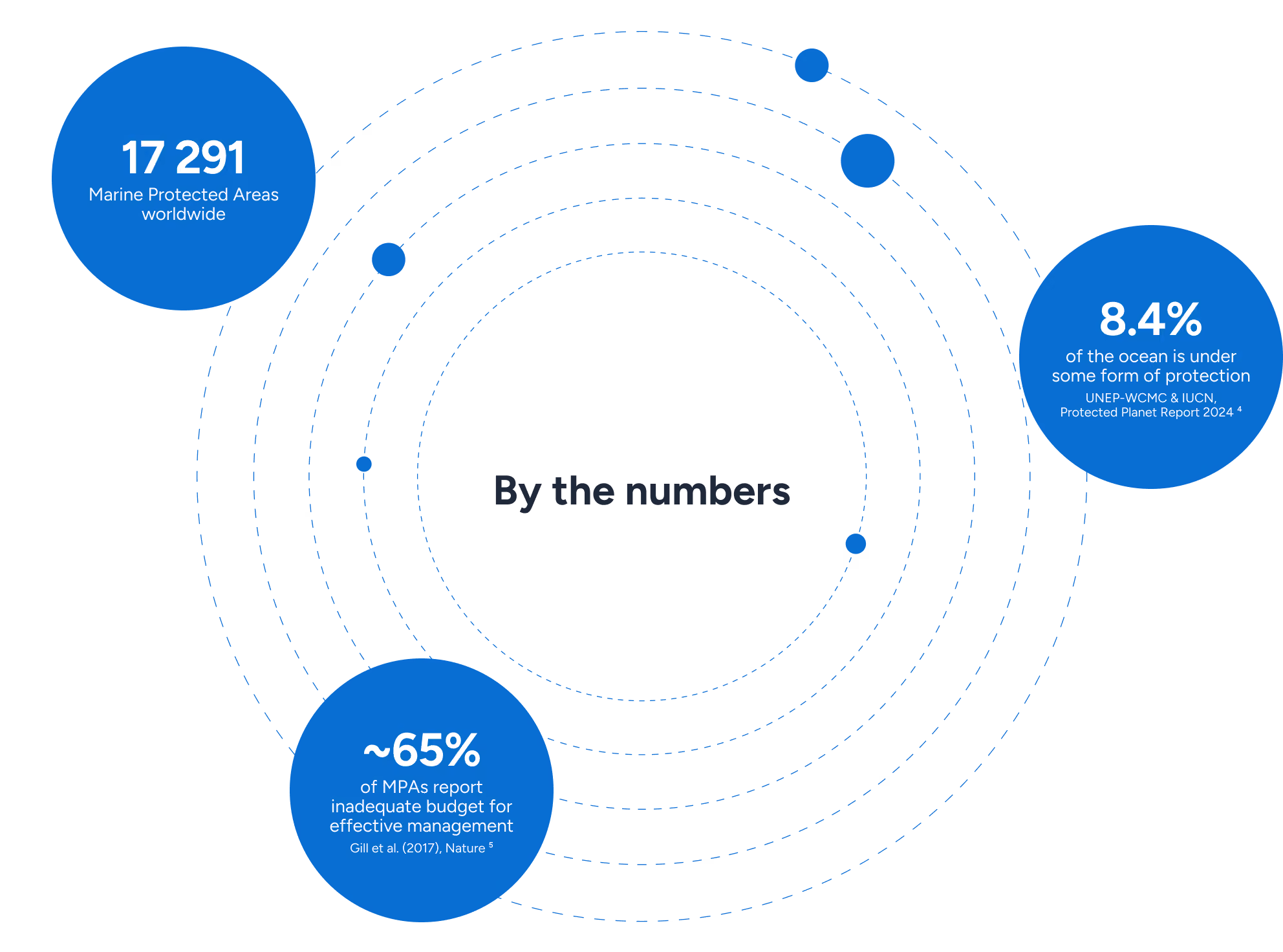
Marine Protected Areas are our most powerful tool for ocean conservation.3 But having them on paper isn't enough. They need to actually work.
Where the world's MPAs are
Explore the global distribution of marine protected areas. Zoom in to see individual sites and click any marker for details.
The gap between designation and protection
Creating an MPA is a political achievement. Making it effective is an operational challenge. Across the globe, MPA managers wrestle with the same fundamental tension: vast ocean areas, limited resources, and mounting pressure to demonstrate that protection is actually delivering results.
Too many MPAs exist only on paper. Without adequate monitoring, enforcement, and evidence of ecological outcomes, even well-intentioned protected areas risk becoming “paper parks”6,7 — boundaries drawn on maps that do little to change what happens beneath the surface.
MPA managers don't just need to do conservation.
They need to prove it's working.
This guide is built for the people at the center of that challenge. Whether you're managing a well-resourced marine park or stretching a thin budget across thousands of square kilometers, this resource is designed to help you understand the landscape, evaluate your options, and build a monitoring strategy that delivers defensible evidence of protection effectiveness.
1. IPBES (2019). Summary for policymakers of the global assessment report on biodiversity and ecosystem services. Díaz, S., Settele, J., Brondízio, E.S., et al. (eds.). IPBES Secretariat, Bonn. DOI: 10.5281/zenodo.3553579
2. FAO (2024). The State of World Fisheries and Aquaculture 2024: Blue Transformation in Action. Rome, FAO. DOI: 10.4060/cd0683en
3. Sala, E., & Giakoumi, S. (2018). No-take marine reserves are the most effective protected areas in the ocean. ICES Journal of Marine Science, 75(3), 1166–1168. DOI: 10.1093/icesjms/fsx059
4. UNEP-WCMC and IUCN (2024). Protected Planet Report 2024. Cambridge, UK: UNEP-WCMC; Gland, Switzerland: IUCN.
5. Gill, D.A., Mascia, M.B., Ahmadia, G.N., et al. (2017). Capacity shortfalls hinder the performance of marine protected areas globally. Nature, 543(7647), 665–669. DOI: 10.1038/nature21708
6. Rife, A.N., Erisman, B., Sanchez, A., & Aburto-Oropeza, O. (2013). When good intentions are not enough… Insights on networks of “paper park” marine protected areas. Conservation Letters, 6(3), 200–212. DOI: 10.1111/j.1755-263X.2012.00303.x
7. Pike, E.P., MacCarthy, J.M.C., Hameed, S.O., et al. (2024). Ocean protection quality is lagging behind quantity. Conservation Letters, e13020. DOI: 10.1111/conl.13020