Satellites see through clouds but not water. Divers see species but visit infrequently. Sensors record conditions but store data locally. Every approach fills part of the picture while leaving gaps elsewhere.
The question is not which tool to use. It is what standards a monitoring program must meet before it can actually inform decisions and demonstrate impact. Five principles separate monitoring that changes outcomes from monitoring that simply produces data.
Continuous, not episodic
The onset of coral bleaching can unfold within a single week.1 A hypoxia event can form overnight.2 Illegal fishing vessels can enter a protected zone, deploy gear, and leave within hours, often faster than the interval between satellite position reports.3 These threats operate on ecological time, not institutional time. A monitoring regime tied to quarterly field campaigns or scheduled survey windows will inevitably miss events that occur between scheduled observations.

The principle is not about collecting data at the highest possible frequency for its own sake. It is about ensuring enough temporal coverage that a significant ecological or enforcement event cannot occur and resolve entirely unseen. When that standard is met, monitoring shifts from documenting the past to observing the present.
Actionable, not archival
Continuous data collection solves one problem. But if that data sits on a logger at the bottom of the ocean until a diver retrieves it months later, it has become an archive, not a management tool. At Lough Hyne, Ireland's only marine nature reserve, independent researchers used years of dissolved oxygen measurements to uncover a serious ecological crisis that official agencies had missed entirely, because no routine monitoring of the reserve existed.4,5
Independent researchers used years of dissolved oxygen measurements to uncover a serious ecological crisis that official agencies had missed entirely, because no routine monitoring of the reserve existed.
Effective monitoring closes the gap between event and awareness. Data reaches a decision-maker while there is still time to act: to dispatch a patrol vessel, to alert downstream communities, to trigger an emergency protocol. This does not require every sensor to transmit in real time, but it does require that the pipeline from sensor to screen is short enough to be operationally relevant.
Integrated, not siloed
A temperature sensor on one dashboard. Vessel tracking data on another. Diver survey results in a spreadsheet. Satellite imagery in yet another platform. When each data stream lives in its own system, managed by its own team, on its own timeline, the result is not a monitoring program. It is a collection of disconnected observations that no single person can synthesize into a coherent picture.
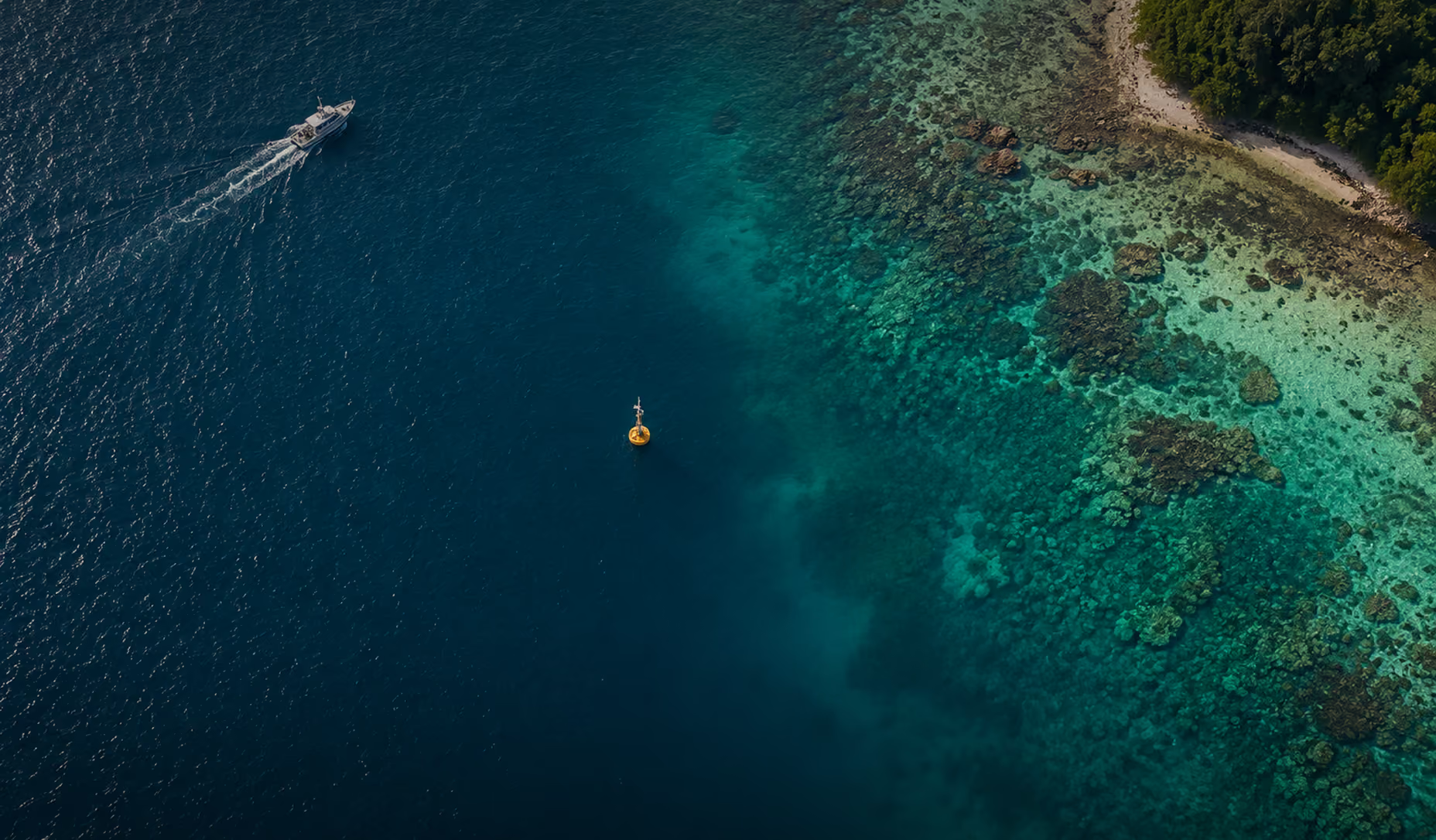
Effective monitoring does not require replacing every tool with a single system. It requires that their outputs converge into a shared view where a manager can see conditions, threats, and trends together. The goal is an operational picture, not a filing cabinet.
Scalable to the area
A monitoring solution that is highly capable but only affordable at a handful of fixed locations has not solved the scale problem. It has relocated it. Instead of no data, the manager now has islands of data surrounded by the same vast unmonitored expanse. Cost per square kilometer matters as much as capability per unit.
MPAs can span thousands of square kilometers. Effective monitoring must be deployable across the actual footprint of the area being protected, not just at the sites where grant funding happened to concentrate. If a system cannot scale to the geography it is meant to cover, it becomes a demonstration project rather than an operational capability.6
exist in monitoring coverage across 4,858 EU MPAs. For most maritime activities, monitoring data covers a minority of total protected area, leaving managers to make decisions about waters they cannot see.
Evidence-grade output
Monitoring data does not stay with the team that collected it. Funders want impact metrics. Governments want compliance reports. Courts want documentation that holds up when an illegal fishing prosecution is challenged. Scientists want data they can cite in peer-reviewed publications. Each of these audiences has a different evidentiary standard, and monitoring that satisfies only one of them creates a bottleneck elsewhere.
Effective monitoring produces data that is documented, calibrated, and attributable. Sensor metadata, calibration records, and timestamps are not administrative overhead. They are what make the difference between a data point and a piece of evidence.
1. Hughes, T. P., Kerry, J. T., Álvarez-Noriega, M., et al. (2017). Global warming and recurrent mass coral bleaching. Nature, 543(7645), 373–377. DOI: 10.1038/nature21707/
2. Altieri, A. H., Harrison, S. B., Seemann, J., et al. (2017). Tropical dead zones and mass mortalities on coral reefs. Proceedings of the National Academy of Sciences, 114(14), 3660–3665. DOI: 10.1073/pnas.1621517114
3. Welch, H., Clavelle, T., White, T. D., et al. (2022). Hot spots of unseen fishing vessels. Science Advances, 8, eabq2109. DOI: 10.1126/sciadv.abq2109
4. Plowman, C. Q., Trowbridge, C. D., Davenport, J., et al. (2020). Stressed from above and stressed from below: dissolved oxygen fluctuations in Lough Hyne. ICES Journal of Marine Science, 77(6), 2106–2117. DOI: 10.1093/icesjms/fsaa108
5. Trowbridge, C. D., Davenport, J., Cottrell, D. M., et al. (2017). Extreme oxygen dynamics in shallow water of a fully marine Irish sea lough. Regional Studies in Marine Science, 11, 9–16. DOI: 10.1016/j.rsma.2016.12.015
6. Aminian-Biquet, J., Sletten, J., Vincent, T., et al. (2025). Major data gaps and recommendations in monitoring regulations of activities in EU marine protected areas. npj Ocean Sustainability, 4, Article 3. DOI: 10.1038/s44183-025-00104-x
7. Pomeroy, R. S., Parks, J. E., & Watson, L. M. (2004). How is your MPA doing? A guidebook of natural and social indicators for evaluating marine protected area management effectiveness. IUCN, Gland, Switzerland.
8. Day, J. C. (2008). The need and practice of monitoring, evaluating and adapting marine planning and management — lessons from the Great Barrier Reef. Marine Policy, 32(5), 823–831. DOI: 10.1016/j.marpol.2008.03.023
9. Johnson, M. D., Scott, J. J., Leray, M., et al. (2021). Rapid ecosystem-scale consequences of acute deoxygenation on a Caribbean coral reef. Nature Communications, 12, 4522. DOI: 10.1038/s41467-021-24777-3
10. Schoepf, V., Stat, M., Falter, J. L., & McCulloch, M. T. (2015). Limits to the thermal tolerance of corals adapted to a highly fluctuating, naturally extreme temperature environment. Scientific Reports, 5, 17639. DOI: 10.1038/srep17639